
TowerLink: keeping thousands of telecom towers up with a field service platform built for remote sites
A telecom infrastructure services company maintained thousands of towers across several states, with outages reported by phone, technicians dispatched by WhatsApp and SLA penalties disputed every month. We built TowerLink: alarm-driven ticketing, smart dispatch, a technician app with site checklists and photo proof, spare-parts tracking and SLA reporting — 25 features for keeping networks up.
SLA penalties and WhatsApp dispatch
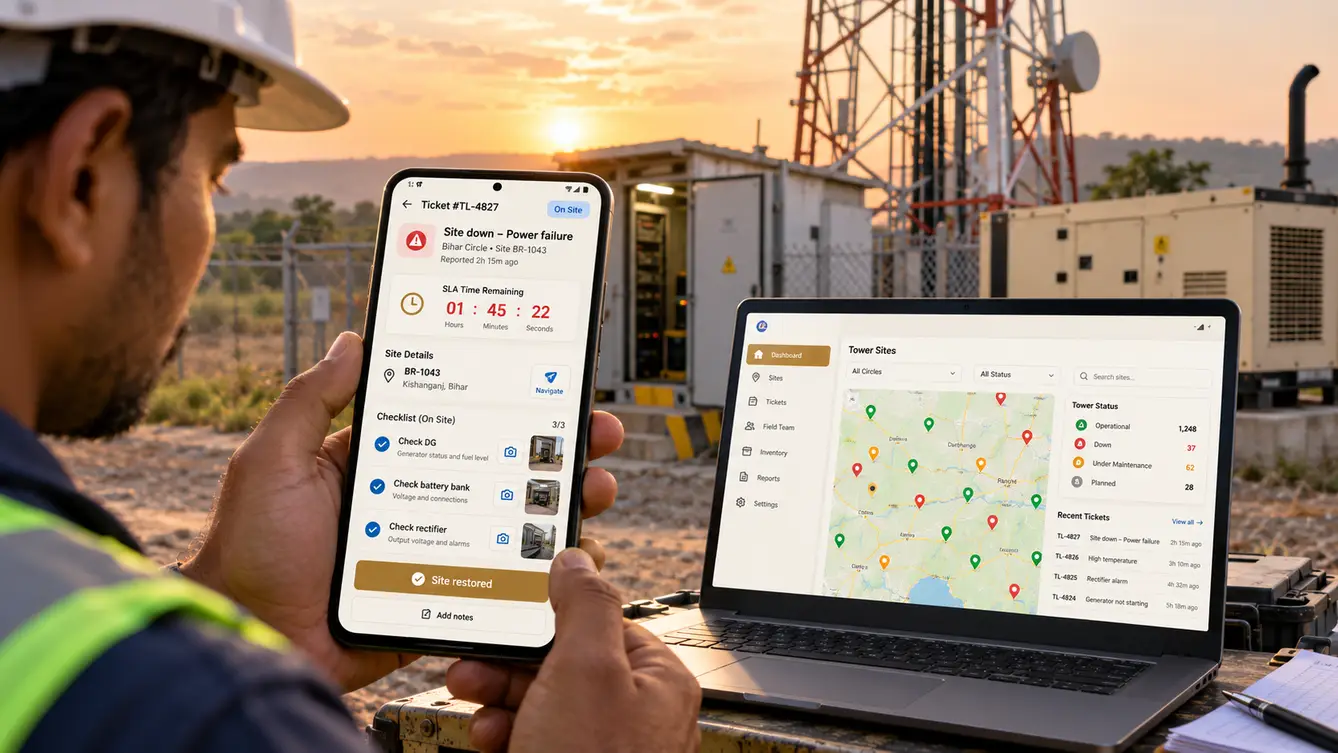
TowerLink maintained towers for mobile operators under strict service-level agreements: outages had to be fixed within set times or penalties applied. Alarms arrived from operators' network systems, a control room called field supervisors, supervisors messaged technicians on WhatsApp, and restoration was confirmed by phone.
At month end, operators and TowerLink argued about penalties. Without timestamps and proof, TowerLink usually lost.
“We fix sites fast. We just can't prove when we fixed them.”
Riding along with technicians
We rode along with technicians on outage calls. Travel time dominated: towers are spread across rural areas, and technicians were often sent to a far site while a closer technician was idle. Many outages were caused by power — generator and battery failures — and the same sites failed repeatedly.
- Dispatch by phone, not by proximity
- No proof of arrival or restoration times
- Spare parts not available at the site
- Repeat failures at the same sites
Alarm to ticket to the nearest technician
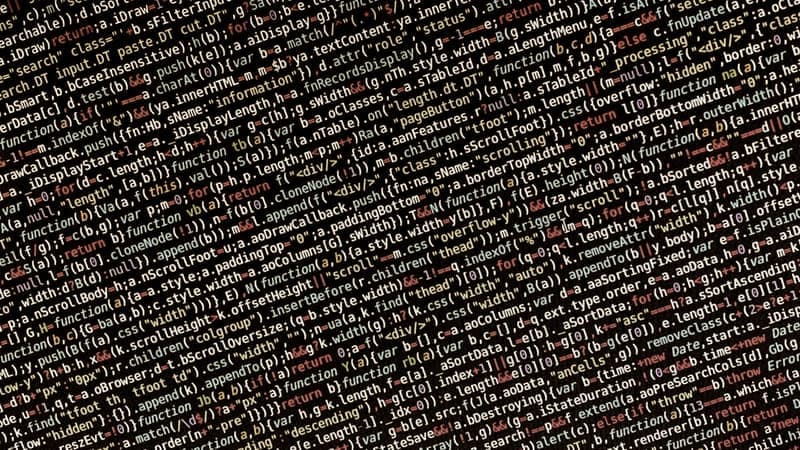
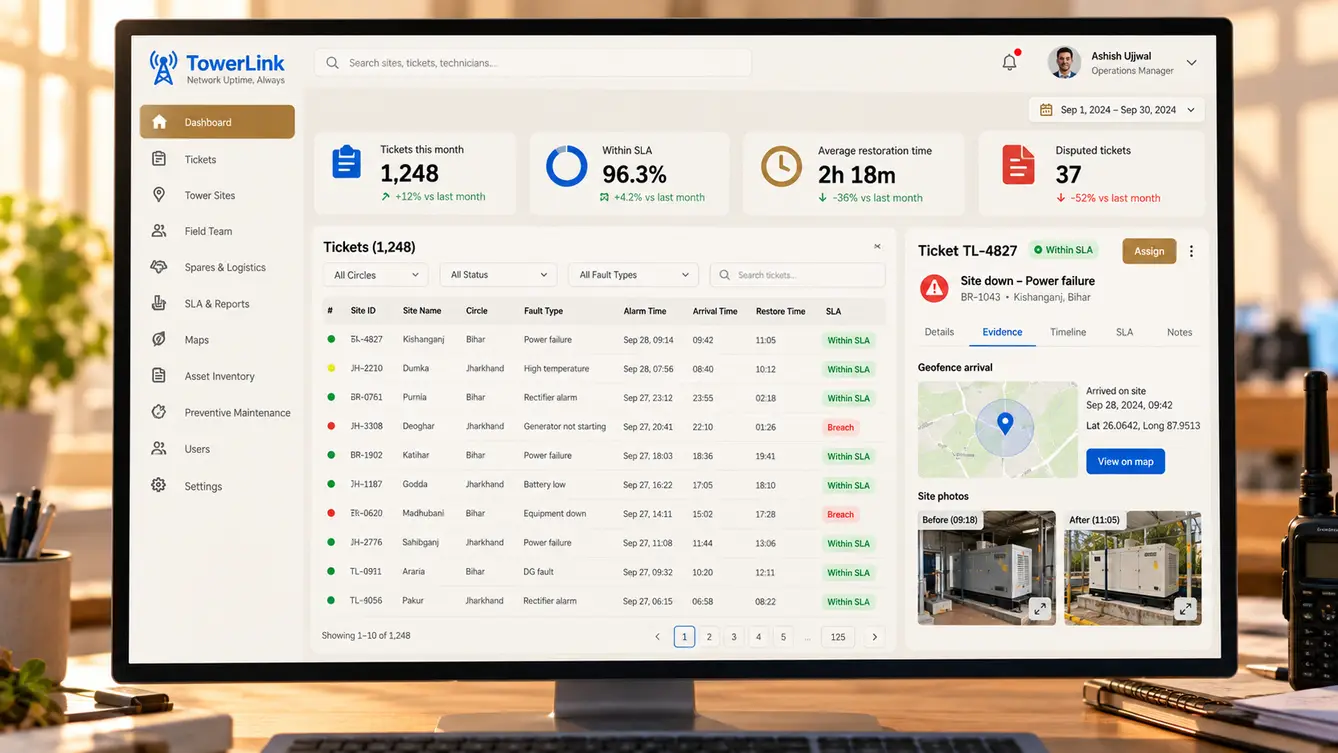
TowerLink ingests alarms from operators' systems and creates tickets automatically. Dispatch suggests the nearest available technician with the right skills and spares, based on live location. The technician app records arrival by geofence, guides the fault checklist, requires photos of the fix and records restoration — all timestamped.
A predictive model flags sites likely to fail soon based on alarm history and generator data, so preventive visits can be scheduled before outages happen.
The team
Integration with operators' alarm feeds was critical, so it was staffed from week one.
Operations workshops and circle rollout.
Technician app, control room and SLA portal.
Technician and spares apps.
Control room, dispatch and SLA portal.
Operator alarm feeds and generator telemetry.
Dispatch optimisation and failure prediction.
7 people in total, working as one team.
Decisions we made
Agreed with operations leadership and circle heads.
Manual or automatic tickets?
- Control room creates tickets
- Tickets created automatically from alarms
Our call: Tickets created automatically from alarms. Automatic ticketing removed minutes from every outage and created an exact start time.
How to dispatch?
- Supervisor chooses
- Suggested nearest qualified technician, supervisor confirms
Our call: Suggested nearest qualified technician, supervisor confirms. Proximity-based suggestions cut travel time while supervisors kept control.
How to prove arrival and restoration?
- Technician reports by phone
- Geofenced arrival and photo-backed restoration
Our call: Geofenced arrival and photo-backed restoration. Evidence captured automatically was accepted by operators in SLA reviews.
Reactive or preventive?
- Fix failures as they happen
- Add failure prediction for preventive visits
Our call: Add failure prediction for preventive visits. Repeat failures at the same sites were predictable; preventive visits avoided outages entirely.
The 25 features
Everything that shipped for the control room, technicians, spares and clients.
- 01Alarm ingestion
Alarms from operators' systems in real time.
- 02Automatic ticketing
Tickets created with SLA timers.
- 03Tower map
Towers and technicians on a live map.
- 04Smart dispatch
Nearest qualified technician suggested.
- 05Escalations
Tickets escalate as SLAs near breach.
- 06Ticket queue
Assigned tickets with navigation.
- 07Geofenced arrival
Arrival recorded automatically at the site.
- 08Fault checklists
Guided troubleshooting by fault type.
- 09Photo proof
Before and after photos required.
- 10Offline mode
Work at sites without signal.
- 11Spares inventory
Stock by warehouse and technician van.
- 12Parts consumption
Parts recorded against tickets.
- 13Site asset register
Generators, batteries and equipment per site.
- 14Generator telemetry
Fuel and runtime data where available.
- 15SLA tracking
Performance by operator, circle and fault type.
- 16Client SLA portal
Operators see tickets and evidence.
- 17Failure prediction
Sites likely to fail soon flagged.
- 18Preventive maintenance
Scheduled visits with checklists.
- 19Repeat failure analysis
Sites and causes that recur.
- 20Technician performance
Response and restoration times.
- 21Role-based access
Control room, technicians, circle heads and clients.
- 22Monthly SLA reports
Operator-ready SLA reports with evidence links.
- 23Site energy tracking
Generator runtime and fuel use per site.
- 24Van stock replenishment
Spares reordered when technician stock runs low.
- 25Audit trail
Every ticket change and dispatch decision recorded.
Rollout by circle
We launched in one circle, compared SLA performance and disputes with the previous quarter, and then rolled out circle by circle. Operators were given access to the SLA portal, which turned monthly penalty arguments into a review of shared evidence.
- Weeks 1–3Discovery
Control room observed; technician ride-alongs.
- Weeks 4–5Design
Technician app and dispatch flows.
- Weeks 6–15Build
Integrations, ticketing, apps, SLA portal and models.
- Weeks 16–18Pilot circle
One circle live; SLA compared with prior quarter.
- Weeks 19–22All circles
Circle-by-circle rollout; operators onboarded to portal.
What we learned
Proof changes commercial conversations. Timestamped evidence resolved most disputes before they started.
Dispatch by proximity is the cheapest speed-up. Sending the nearest qualified technician cut travel time more than any process change.
- Next.js
- React Native
- NestJS
- PostgreSQL with PostGIS
- Alarm feed integration
- Dispatch optimisation
- Predictive failure model
- AWS Mumbai