FiberDesk: helping a regional broadband provider install faster, bill cleanly and fix outages before customers call
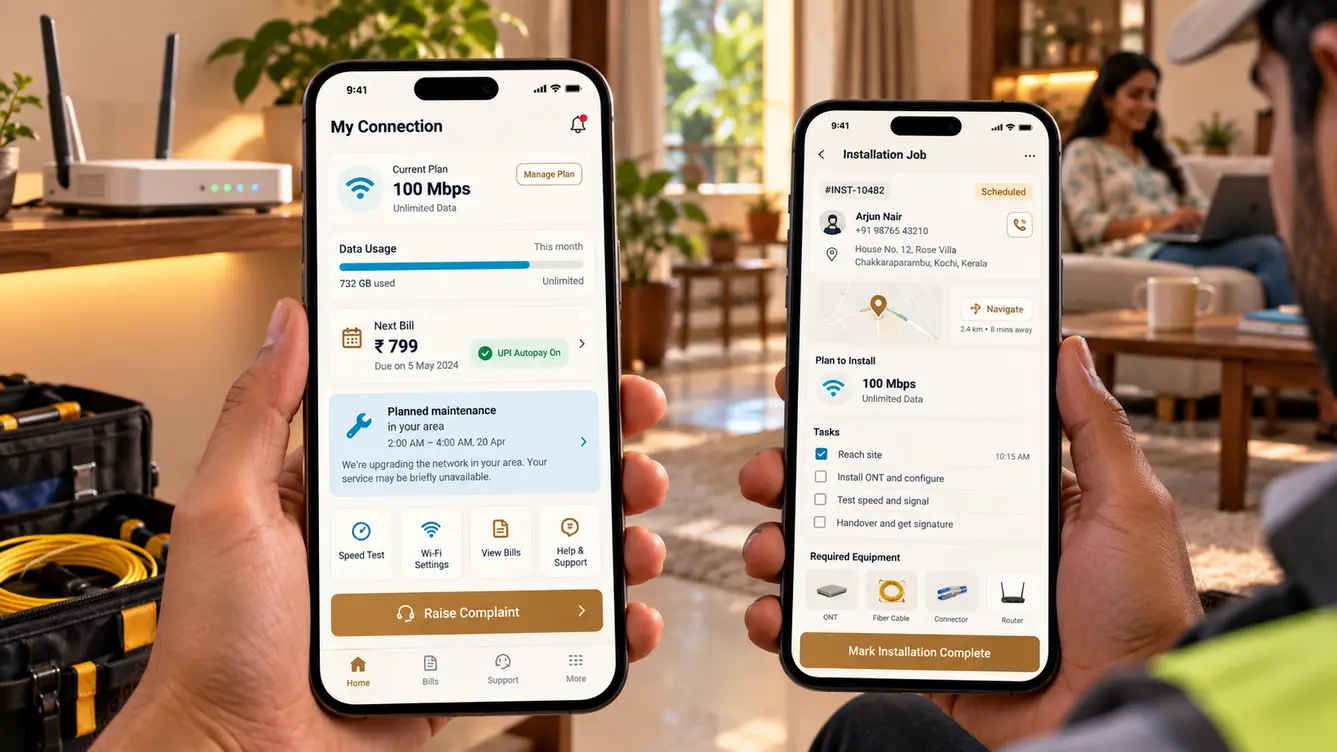
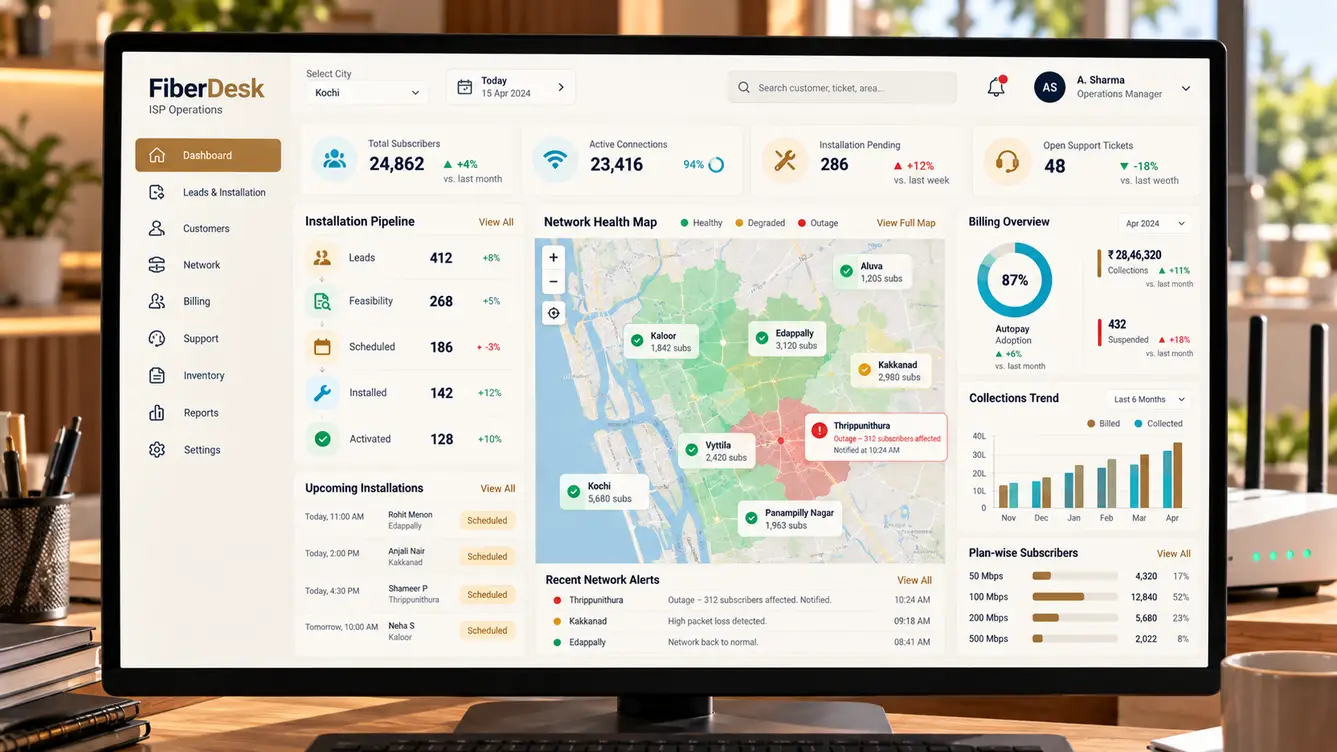
A regional fibre broadband provider had grown to tens of thousands of subscribers in smaller cities, managed through a mix of spreadsheets, a legacy billing tool and technicians on WhatsApp. We built FiberDesk: lead-to-installation workflow, subscriber and plan management, automatic billing with UPI Autopay, network outage detection and a customer self-care app.
Growing faster than the back office
FiberDesk's founder had built a fibre network across smaller cities, often faster than larger operators. The back office had not kept up: installation requests tracked in spreadsheets, billing on a legacy tool that did not talk to the network, and customers calling to report outages the network team already knew about.
“We lay fibre fast. Everything after the fibre is slow.”
Mapping the subscriber lifecycle
We mapped a subscriber's lifecycle from enquiry to installation, billing, support and renewal. Installations stalled waiting for technicians and equipment. Suspensions for non-payment were manual. Outages generated call spikes that overwhelmed support.
- Installations tracked in spreadsheets
- Billing disconnected from the network
- Manual suspensions and reactivations
- Outage call spikes

The network and the business, connected
FiberDesk connects business systems to the network. When a plan is activated, the subscriber's speed profile is set in the network automatically; when payment fails, service moves to a grace state and then suspends, and restores the moment payment arrives. Installation jobs flow to technicians with equipment reserved.
Network monitoring detects outages by area and notifies affected customers proactively, with estimated restoration times, before the phones start ringing.
The team
Network integration required an engineer familiar with RADIUS and OLT management.
Lifecycle mapping and city migrations.
Self-care app and operations console.
Billing, CRM, installations and partner portal.
RADIUS, OLT and monitoring.
Customer and technician apps.
6 people in total, working as one team.
Decisions we made
Agreed with the founder and network head.
Manual or automatic provisioning?
- Network team provisions manually
- Automatic provisioning from plan changes
Our call: Automatic provisioning from plan changes. Automation removed delays and errors in activation and suspension.
Reactive or proactive outage handling?
- Wait for complaints
- Detect and notify affected customers
Our call: Detect and notify affected customers. Customers told first called less and trusted more.
Migrate all at once?
- Big-bang migration
- City by city with reconciliation
Our call: City by city with reconciliation. Billing accuracy mattered more than speed.
Every feature, module by module
Everything that shipped for subscribers, technicians, operations and partners.
- 01Self-care app
Plan, usage, bills and complaints.
- 02UPI Autopay
Automatic monthly payments.
- 03Plan upgrades
Change plans instantly.
- 04Outage notifications
Proactive alerts with restoration time.
- 05Complaint tracking
Status until resolved.
- 06Lead management
Enquiries and feasibility.
- 07Technician app
Jobs, equipment and photos.
- 08Equipment inventory
Routers and ONTs tracked.
- 09Automatic activation
Service live on completion.
- 10Plan and billing engine
Monthly and prepaid plans.
- 11Automatic suspension and restore
Linked to payment status.
- 12RADIUS integration
Speed profiles set automatically.
- 13Outage detection
Area-level network monitoring.
- 14GST invoicing
Compliant invoices.
- 15Franchise partner portal
Partners manage local subscribers.
- 16Revenue sharing
Partner settlements.
- 17Operations dashboard
Installs, collections and churn.
- 18Role-based access
Operations, technicians, partners and subscribers.
- 19Audit trail
Account and billing changes recorded.
Migration
Subscribers were migrated city by city from the legacy billing tool, with each account reconciled before switching. Autopay was offered at the next bill with a small discount, and adoption was strong from the first cycle.
- Weeks 1–3Discovery
Subscriber lifecycle and network audit.
- Weeks 4–5Design
Self-care app and operations flows.
- Weeks 6–15Build
Billing, provisioning, apps and monitoring.
- Weeks 16–19City migrations
Accounts reconciled city by city.
- Week 20All subscribers
Legacy billing retired.
What we learned
Connect business systems to the network. Automatic activation and suspension removed a whole category of manual work.
Tell customers first. Proactive outage messages cut support calls sharply.
- React Native
- Next.js
- NestJS
- PostgreSQL
- RADIUS and OLT integration
- UPI Autopay
- WhatsApp Business API
- AWS Mumbai