
RouteBee: helping a last-mile delivery company deliver more parcels per rider without burning them out
A last-mile delivery company for D2C brands planned routes on spreadsheets each morning, and failed deliveries came back every evening. We built RouteBee: automatic route optimisation, a rider app with navigation and proof of delivery, customer notifications with live tracking, COD reconciliation and failed-delivery prevention — so riders spend less time lost and customers are home when they arrive.
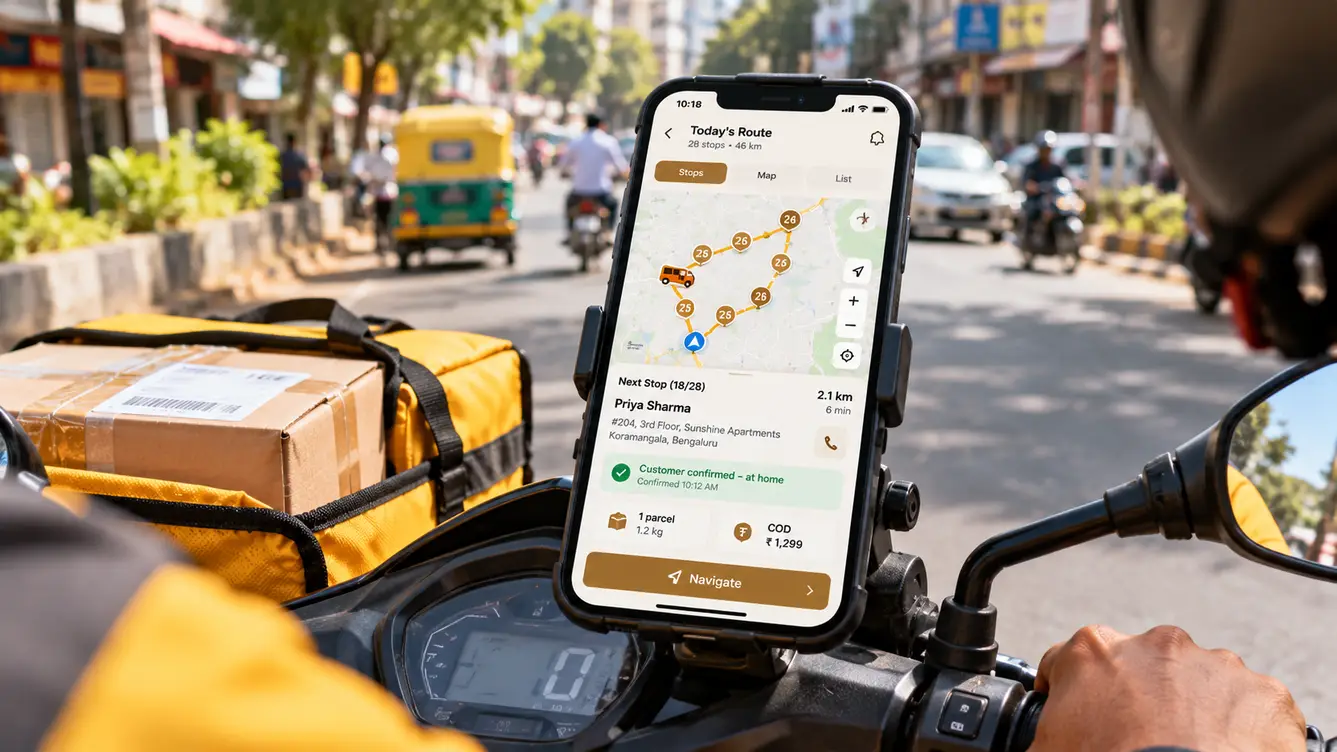
Mornings with a spreadsheet, evenings with returns
RouteBee's hub managers spent the first hour of every day sorting parcels into routes by area knowledge and a spreadsheet. Riders then crossed each other's paths all day. By evening, a stack of parcels came back: customers not home, addresses not found, COD cash not ready.
“A failed delivery costs us twice and the rider's evening too.”
Why deliveries failed
We analysed failed deliveries and rode with riders. Most failures were predictable: vague addresses, customers unavailable at the attempt time and unprepared COD payments. Routes were inefficient because nobody could optimise dozens of stops across dozens of riders by hand.
- Addresses that could not be located
- Customers not available at attempt time
- COD cash or UPI not ready
- Inefficient routes leaving too little time

Confirm, optimise, deliver
Every morning, RouteBee geocodes addresses — learning from past successful deliveries to fix vague ones — and optimises routes across riders with time windows and vehicle capacity. Customers get a WhatsApp message to confirm availability, share a location pin or reschedule, and pay by UPI in advance if they want.
Riders follow an ordered route with navigation, capture proof of delivery and collect COD by UPI QR, reconciled automatically at the hub.
The team
Route optimisation and address intelligence were the core technical challenges.
Hub observation and rollout.
Rider app and hub console.
Rider app with navigation and proof of delivery.
Hub console, brand portal and notifications.
Route optimisation and address geocoding.
6 people in total, working as one team.
Decisions we made
Agreed with the operations head and hub managers.
Manual routes or optimisation?
- Hub managers plan routes
- Automatic optimisation, editable by managers
Our call: Automatic optimisation, editable by managers. Optimisation handled scale; managers kept control for local knowledge.
How to reduce failed deliveries?
- Retry more often
- Confirm availability and fix addresses before dispatch
Our call: Confirm availability and fix addresses before dispatch. Preventing failures was cheaper than retrying them.
COD handling?
- Cash only
- UPI QR at the door, prepay links in advance
Our call: UPI QR at the door, prepay links in advance. Digital COD reduced cash handling and reconciliation errors.
Every feature, module by module
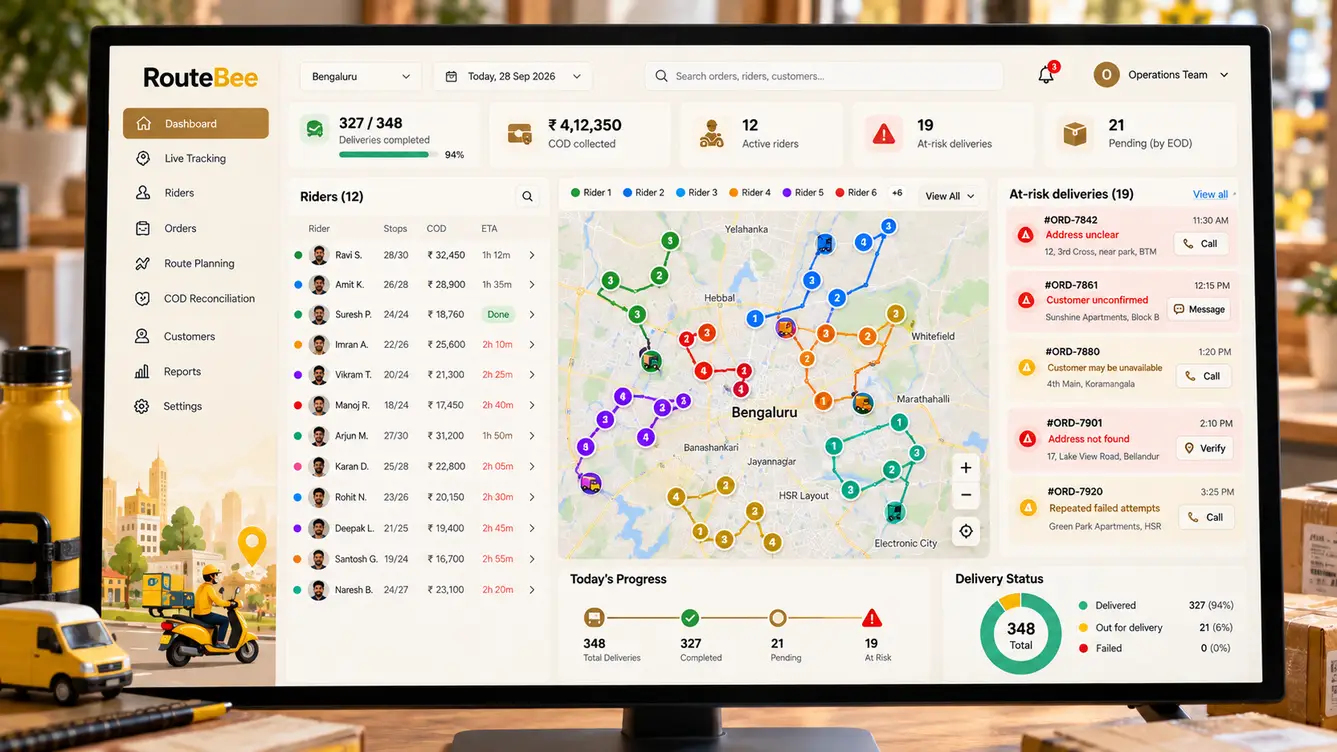
Everything that shipped for riders, hubs, customers and brands.
- 01Optimised route
Ordered stops with navigation.
- 02Customer status
Confirmed, rescheduled or unreachable.
- 03Proof of delivery
Photo, OTP or signature.
- 04UPI COD collection
QR payments at the door.
- 05Earnings view
Deliveries and incentives.
- 06Route optimisation
Across riders with time windows.
- 07Address geocoding
Learning from past deliveries.
- 08Live rider tracking
Progress on the map.
- 09At-risk alerts
Deliveries likely to fail.
- 10COD reconciliation
Cash and UPI matched per rider.
- 11Availability confirmation
Confirm or reschedule on WhatsApp.
- 12Location pin sharing
Share exact location.
- 13Live tracking link
Rider ETA on delivery day.
- 14Prepay links
Pay COD orders in advance.
- 15Brand portal
Shipments, status and PODs.
- 16Performance reports
Delivery success and times.
- 17API integration
Orders in, status out.
- 18Role-based access
Riders, hubs, brands and admins.
- 19Audit trail
Every delivery event recorded.
Rollout
One hub piloted RouteBee for a month; riders' suggestions on stop order and app layout were built in. The remaining hubs followed, each starting with rider training at the morning briefing.
- Weeks 1–2Discovery
Failed deliveries analysed; rider ride-alongs.
- Weeks 3–4Design
Rider app and confirmation flow.
- Weeks 5–11Build
Optimisation, apps, notifications and COD.
- Weeks 12–15Hub pilot
One hub for a month.
- Week 16All hubs
Rollout with morning briefings.
What we learned
Prevent failures before the rider leaves. Confirmation messages and address fixes did more than faster riding.
Riders are the experts. Their feedback improved routes the algorithm could not.
- React Native
- Next.js
- NestJS
- PostgreSQL with PostGIS
- Route optimisation engine
- Address geocoding model
- WhatsApp and SMS
- AWS Mumbai