
Haulwise: taking a 300-truck fleet from phone calls and paper LRs to a live transport management system
A mid-mile trucking company moved goods for manufacturers across north India with trip planning on phone calls, lorry receipts on paper and billing disputes that took months. We built Haulwise: load planning, a driver app with e-POD, GPS and FASTag tracking, freight billing and a shipper portal — 26 features that turned every trip into a traceable record from booking to payment.
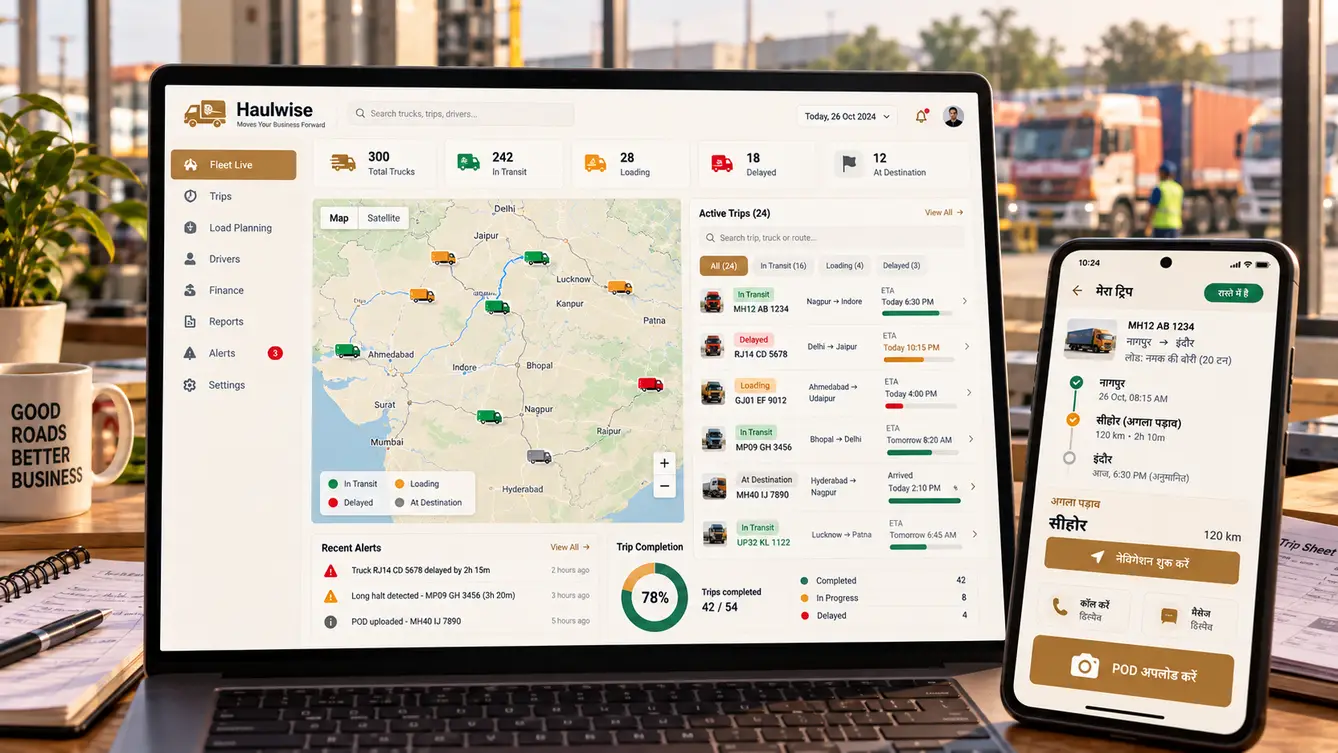
Four phones and a whiteboard
Haulwise's operations room had a whiteboard listing trucks and trips, and four supervisors each with two phones. They spent the day calling drivers to ask where they were and calling shippers to explain delays. Lorry receipts and proof-of-delivery slips travelled back to the office with drivers — sometimes weeks later — and billing could not start until they arrived.
The result was a business with good trucks and good drivers that waited months to get paid and argued with customers about detention charges it could not prove.
“We deliver on time. We just can't prove it until the paper comes back.”
Following a single trip
We followed a trip from Nagpur to a factory in Gujarat and back with a return load. The trip touched the booking, a load plan, an advance to the driver for fuel and tolls, a paper LR, GPS pings nobody watched, a proof of delivery signed on paper, detention at the unloading point, and finally an invoice raised weeks later.
Every step existed. None of them were connected. Haulwise's job was to connect them into one trip record.
- Invoices delayed until paper PODs returned
- Detention charges disputed without evidence
- Driver advances reconciled by hand
- Empty return legs not planned in advance

A driver app that drivers use
The driver app does four things: show the trip, record key events with one tap (reached, loading started, departed, unloaded), capture the signed POD with the camera, and log expenses against the advance. It is in Hindi, works offline and needs no typing. Drivers who use it get their settlements faster, which did more for adoption than any instruction from the office.
Tracking uses the trucks' GPS devices and FASTag toll events, so the office sees progress even when a driver's phone is off.
The team
Integrations with GPS vendors and FASTag data were critical, so an integration engineer was on the team from the start.
Operations workshops, driver onboarding and shipper rollout.
Driver app, operations app and shipper portal.
Offline Hindi driver app.
Operations app, shipper portal and finance console.
Trips, billing, advances and reconciliation.
GPS vendors, FASTag and e-way bill integrations.
POD and document extraction, ETA prediction.
8 people in total, working as one team.
Decisions we made
Agreed with operations, finance and senior drivers.
Track drivers' phones or trucks?
- Driver phone GPS only
- Truck GPS devices plus FASTag events
Our call: Truck GPS devices plus FASTag events. Phones get switched off or left behind. Truck GPS and toll events gave reliable tracking without depending on the driver.
Paper LRs or digital?
- Keep paper
- Digital LR and e-POD with photo proof
Our call: Digital LR and e-POD with photo proof. Digital documents available the moment they are signed let invoicing start on delivery day.
Build on an off-the-shelf TMS?
- Generic TMS
- Custom system for mid-mile trucking with advances and detention
Our call: Custom system for mid-mile trucking with advances and detention. Generic TMS products did not handle driver advances, detention billing or return-load planning the way Haulwise operated.
How to predict ETAs?
- Distance divided by average speed
- Model using lane history, time of day and stops
Our call: Model using lane history, time of day and stops. Lane history made ETAs honest, which mattered more to shippers than optimistic ones.
The 26 features
Everything that shipped across operations, drivers, shippers and finance.
- 01Trip booking
Orders from shippers converted to trips.
- 02Load planning
Assign trucks and plan return loads.
- 03Live fleet map
Truck positions and status from GPS.
- 04Delay alerts
Alerts when trips fall behind ETA.
- 05ETA prediction
Lane-based arrival estimates.
- 06E-way bill integration
Generate and extend e-way bills.
- 07Trip details
Stops, contacts and documents offline.
- 08One-tap milestones
Reached, loading, departed and unloaded.
- 09E-POD capture
Signed POD photographed at delivery.
- 10Expense logging
Fuel, tolls and other expenses against advances.
- 11Settlement status
Drivers see their settlements.
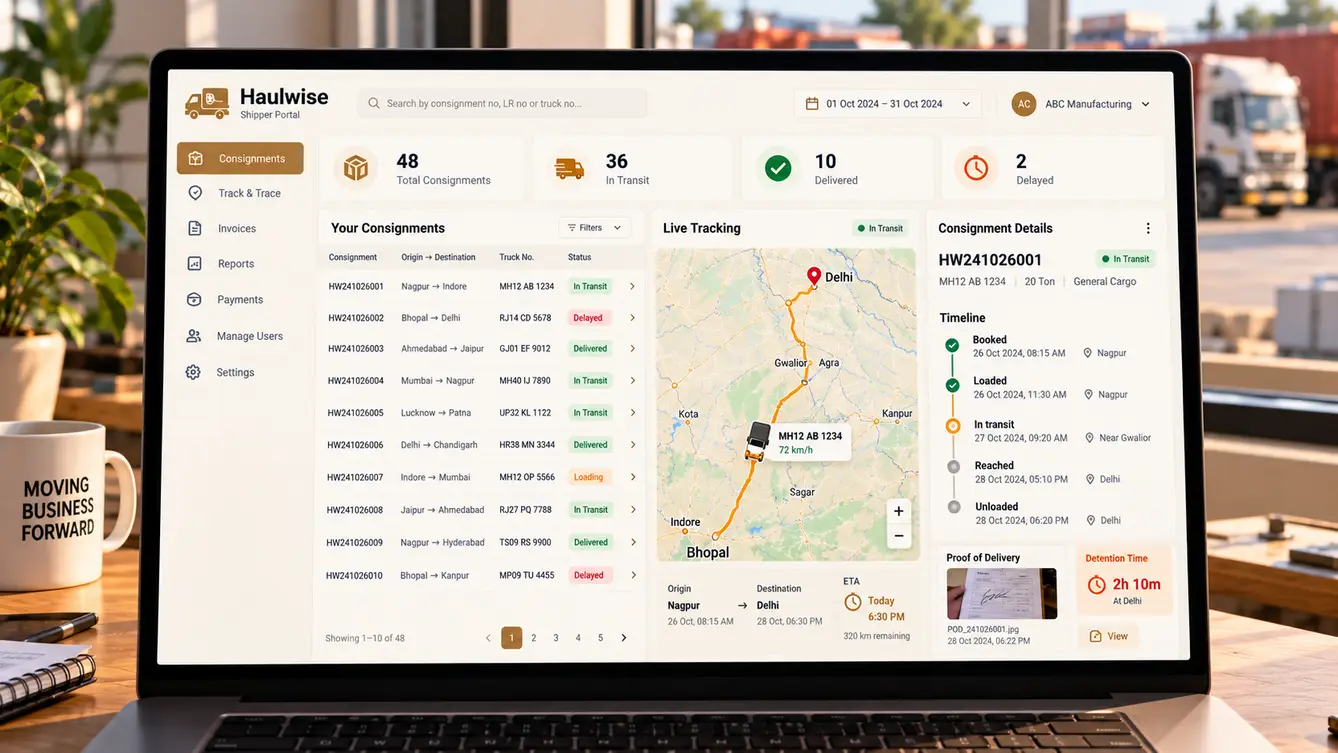
- 12Shipper portal
Consignments, tracking and documents.
- 13Live tracking links
Shareable tracking for each consignment.
- 14POD access
Signed PODs available within hours.
- 15WhatsApp updates
Key milestones on WhatsApp.
- 16Freight invoicing
Invoices raised on delivery with POD attached.
- 17Detention billing
Detention calculated from recorded times.
- 18Advance reconciliation
Driver advances matched with expenses.
- 19Receivables tracking
Outstanding invoices by shipper.
- 20Trip profitability
Revenue, fuel, tolls and driver costs per trip.
- 21Document OCR
Extract data from bills and receipts.
- 22Accounting export
Invoices and expenses to accounts.
- 23Role-based access
Operations, drivers, shippers and finance.
- 24Audit trail
Every change to trips and invoices recorded.
- 25Fleet utilisation reports
Loaded versus empty kilometres by truck.
- 26Compliance reminders
Permits, insurance and fitness renewals.
Rolling out to the fleet
We started with trucks on the busiest lane and a group of experienced drivers who became the app's champions at the loading yards. Shippers were onboarded to the portal next; the first time a customer saw a signed POD within an hour of delivery, they asked for the portal for every lane.
- Weeks 1–3Discovery
Operations room observed; one round trip followed end to end.
- Weeks 4–6Design
Driver app tested at loading yards.
- Weeks 7–16Build
Operations, driver app, integrations, portal and finance.
- Weeks 17–19Pilot lane
Busiest lane with champion drivers.
- Weeks 20–22Full fleet
All trucks and shippers onboarded.
What we learned
Tie adoption to what users care about. Drivers adopted the app because it sped up their settlements.
Evidence shortens payment cycles. Instant PODs and recorded detention times ended most billing disputes before they started.
- Next.js
- React Native
- NestJS
- PostgreSQL with PostGIS
- GPS telematics and FASTag integration
- Document OCR
- WhatsApp Business API
- AWS Mumbai