
Receivo: getting small suppliers paid in days by turning their invoices into working capital
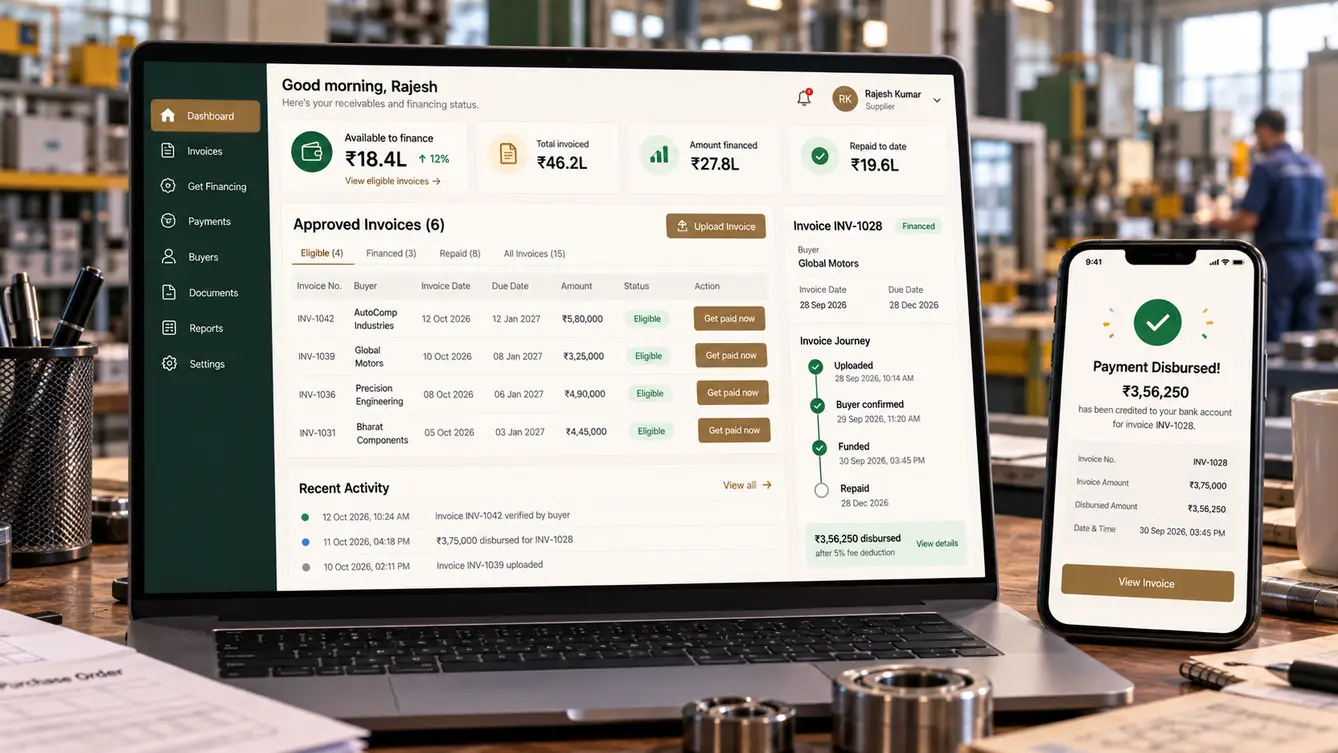
Small manufacturers supplying large companies waited 60 to 90 days to be paid, and banks would not lend against their invoices. A fintech startup set out to fix that. We built Receivo: supplier onboarding with digital KYC, invoice verification with the buyer, lender bidding, disbursal and automatic repayment on the due date — an invoice-financing platform where every rupee is traceable.
Ninety days is a long time for a small factory
Receivo's founder had grown up in a family business that made components for large automotive companies. He remembered his father paying workers on time while waiting three months for buyers to pay invoices, and borrowing informally at painful rates to bridge the gap.
Banks were reluctant to lend to small suppliers. But the invoices were owed by large, creditworthy buyers. If an invoice could be verified with the buyer, it could be financed against the buyer's credit rather than the supplier's.
“The money exists. It's just stuck in someone else's payables department.”
Building trust between three parties
Invoice financing only works if lenders trust that an invoice is real and will be paid. We interviewed suppliers, buyers' finance teams and lenders. Lenders' fear was fraud: fake or duplicate invoices. Buyers' fear was extra work. Suppliers' fear was paperwork and hidden charges.
The design had to answer each: verification against GST e-invoice records and buyer confirmation, a one-click approval flow for buyers, and a transparent all-in cost shown to suppliers before they accept.
- Lenders: proof the invoice is real, unique and acknowledged
- Buyers: approval in one click, no new process
- Suppliers: fast money and one clear price
- Everyone: a ledger that reconciles to the rupee

A ledger at the core
Every movement of money — disbursal, fee, repayment, refund — is recorded in a double-entry ledger, so balances for suppliers, buyers and lenders always reconcile. Duplicate financing is impossible because each invoice is fingerprinted by its GST identifiers the moment it is uploaded.
On the due date, the buyer pays into a designated account and Receivo splits the payment automatically between the lender and the supplier.
The team
Ledger correctness and integrations drove the staffing, with a dedicated engineer for GST and banking APIs.
Founder, lender and buyer workshops.
Supplier, buyer and lender experiences.
Ledger, financing workflows and repayment splits.
GST, e-invoice, KYC and banking APIs.
Supplier app, buyer portal and lender console.
Ledger reconciliation and money-movement tests.
7 people in total, working as one team.
Decisions we made
Agreed with the founders, their compliance adviser and two partner lenders.
How to stop duplicate financing?
- Manual checks
- Fingerprint every invoice by its GST identifiers
Our call: Fingerprint every invoice by its GST identifiers. An invoice can only be financed once. Fingerprinting on upload made duplicates impossible.
Balances or a ledger?
- Store balances per account
- Double-entry ledger for every movement
Our call: Double-entry ledger for every movement. A ledger reconciles by design and gives auditors a complete history.
Hold money or route it?
- Receivo holds funds
- Funds flow through regulated partner accounts
Our call: Funds flow through regulated partner accounts. Routing through partner banks and escrow kept the platform within regulatory boundaries.
Show suppliers a rate or a total cost?
- Annual interest rate
- One all-in amount before acceptance
Our call: One all-in amount before acceptance. Suppliers wanted to know exactly what they would receive. One clear number built trust.
Every feature, module by module
Everything that shipped for suppliers, buyers, lenders and operations.
- 01Digital onboarding
KYC, bank verification and business checks online.
- 02Invoice upload
Upload or fetch e-invoices automatically.
- 03Instant eligibility
See which invoices can be financed.
- 04All-in cost preview
Exact amount received before accepting.
- 05Disbursal tracking
Status from acceptance to bank credit.
- 06Invoice confirmation
Approve supplier invoices in one click.
- 07Supplier programme dashboard
Suppliers onboarded and invoices financed.
- 08ERP integration
Approved invoices synced from the buyer's ERP.
- 09Payment instructions
Due-date payments to the designated account.
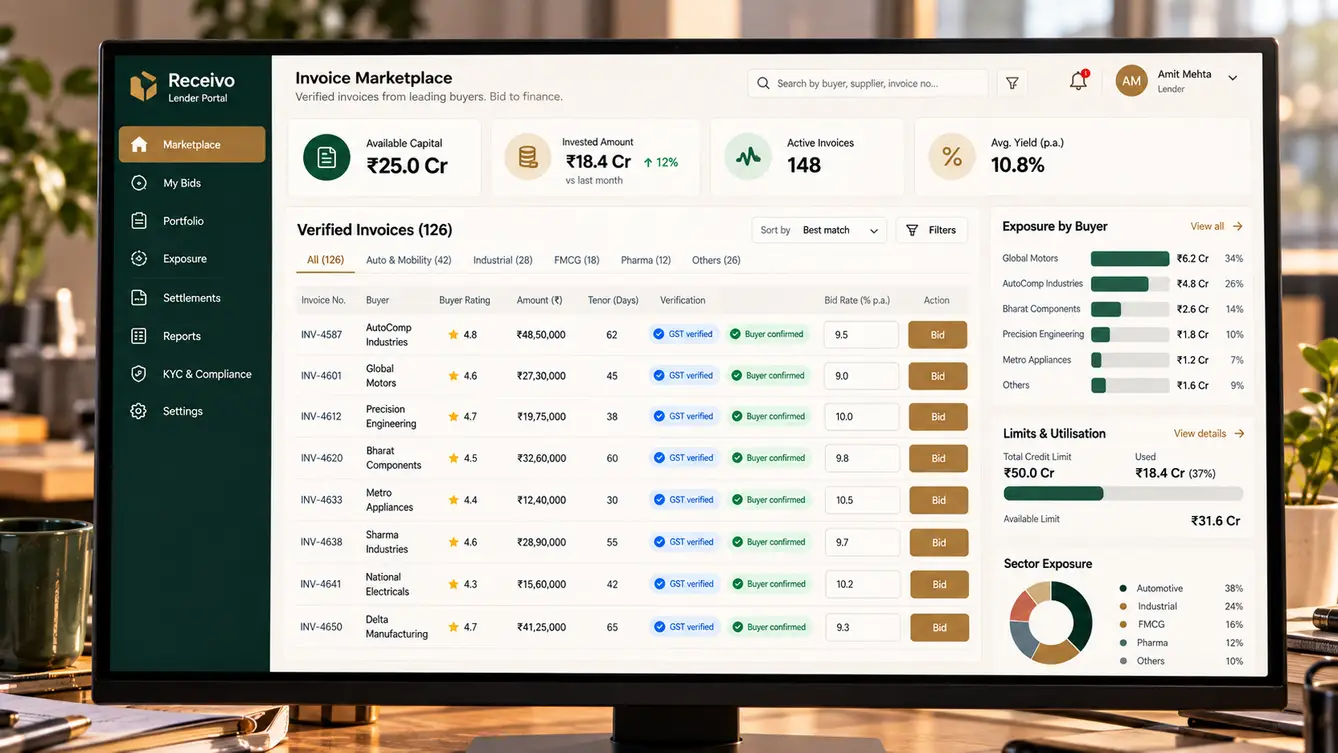
- 10Invoice marketplace
Verified invoices with buyer details.
- 11Bidding
Lenders bid rates on invoices or programmes.
- 12Exposure limits
Limits by buyer, supplier and sector.
- 13Portfolio reports
Outstanding, repaid and overdue.
- 14Double-entry ledger
Every money movement recorded.
- 15Duplicate detection
Invoices fingerprinted on upload.
- 16GST verification
Invoices checked against GST records.
- 17Automatic repayment split
Buyer payments split to lender and supplier.
- 18Overdue management
Reminders and escalation.
- 19Reconciliation reports
Daily reconciliation with bank statements.
- 20Role-based access
Suppliers, buyers, lenders and operations.
- 21Audit trail
Every approval and transaction recorded.
First disbursal
Receivo launched with two lenders and a handful of anchor buyers whose suppliers were invited together. The first supplier was paid within a day of uploading an invoice that would otherwise have taken ninety to settle.
- Weeks 1–3Discovery
Supplier, buyer and lender interviews.
- Weeks 4–6Design
Flows and ledger model agreed with lenders.
- Weeks 7–16Build
Apps, ledger, verification and repayment.
- Weeks 17–19Pilot programme
One anchor buyer and its suppliers.
- Week 20First disbursal
Live with two lenders.
What we learned
In lending, verification is the product. Buyer confirmation and GST checks made lenders comfortable enough to price competitively.
Onboard ecosystems, not individuals. Inviting a buyer together with its suppliers created trust on both sides at once.
- Next.js
- NestJS
- PostgreSQL
- Double-entry ledger
- GST and e-invoice verification APIs
- Account Aggregator
- Document OCR
- AWS Mumbai