
Quizora Live: building a live trivia game show where a hundred thousand players answer in the same ten seconds
A gaming startup wanted a scheduled live trivia show — a host, a countdown, and huge numbers of players answering at the same instant. We built Quizora Live: a real-time game engine, host studio, AI-assisted question production in multiple languages, anti-cheat and a friends-and-leagues layer — 24 features engineered for the moment everyone taps at once.
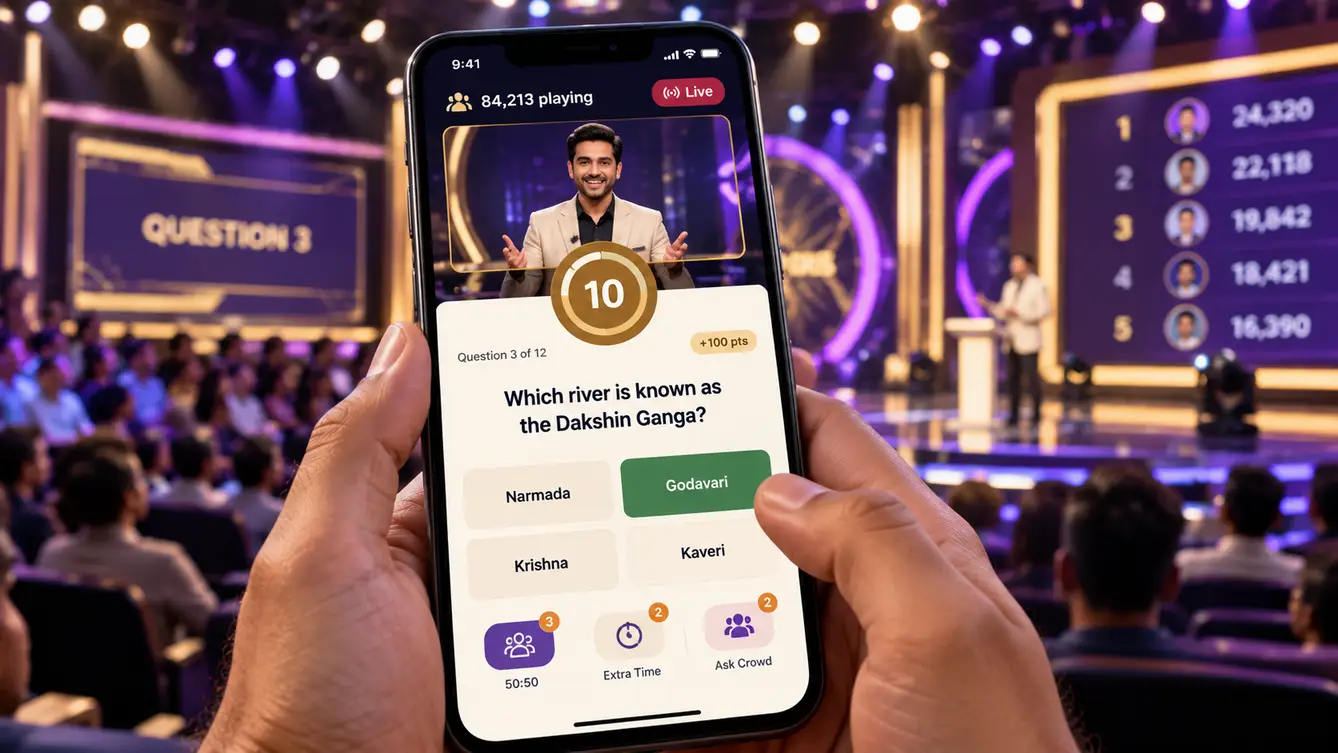
Appointment gaming
Quizora's founders wanted to bring back appointment entertainment: a live show at the same time every evening, with a host, where everyone plays the same questions together. The format is simple; the engineering is not. Every question creates a burst where huge numbers of players submit answers within the same few seconds, and every one of them must be counted fairly.
They had tried a prototype on a general-purpose backend. It worked for a few hundred testers and collapsed at a few thousand.
“The game is ten seconds long. Everything has to work in those ten seconds.”
Designing for the burst
We designed the game engine around the burst. Questions are pushed to all players simultaneously over persistent connections. Answers are accepted by stateless edge servers, timestamped against the server clock and written to an in-memory store, then tallied in parallel. Results are computed once and broadcast, rather than each player asking the server for their result.
We load-tested with simulated players far beyond the launch target, repeatedly, until the burst of answers looked uneventful on our dashboards.
Fairness and anti-cheat
A live game with prizes attracts cheaters. We timestamped answers on the server, compensated for network latency within strict limits, detected impossible response times and flagged accounts that shared devices or answered identically in suspicious patterns. Players see a clear fairness policy, and flagged winners are reviewed before prizes are released.
The team
Real-time engineering led the team, with a dedicated SRE for load testing and show-night operations.
Show format workshops and launch rehearsals.
Game UI, host studio and production console.
Game app with real-time connection handling.
Game engine, answer tallying and anti-cheat.
Load testing, autoscaling and show-night operations.
Question drafting, translation and fact-check workflow.
8 people in total, working as one team.
Decisions we made
Each was driven by the demands of the burst.
Polling or persistent connections?
- Clients poll for questions
- Persistent WebSocket connections
Our call: Persistent WebSocket connections. Polling from huge numbers of clients would itself create a load spike. Persistent connections push each question to everyone at once.
Client time or server time?
- Trust the device clock
- Server timestamps with bounded latency compensation
Our call: Server timestamps with bounded latency compensation. Device clocks can be manipulated. Server time kept the game fair.
AI-written questions?
- Fully AI-generated questions
- AI drafts, humans fact-check and approve
Our call: AI drafts, humans fact-check and approve. A wrong answer on a live show is a public mistake. AI speeds up drafting and translation; editors verify every question.
How much to load test?
- Test at expected traffic
- Test far beyond it, repeatedly
Our call: Test far beyond it, repeatedly. Viral growth is unpredictable. Headroom meant a surprise surge would not end the show.
The 24 features
Everything that shipped for players, the host studio and the question team.
- 01Live synchronised questions
Every player sees the question at the same moment.
- 02Countdown answering
Tap to answer within the time limit.
- 03Host video stream
Low-latency host video in the app.
- 04Instant results
Answer distribution revealed after each question.
- 05Lifelines
Extra lives earned through referrals.
- 06Friends and invites
Invite friends and see who is playing.
- 07Private leagues
Leagues for friends, colleges and offices.
- 08Leaderboards
Daily, weekly and all-time rankings.
- 09Shareable results
Share scores and wins.
- 10Question bank
Questions tagged by topic, difficulty and language.
- 11AI question drafting
Drafts generated for editors to verify.
- 12Multi-language questions
Questions translated and reviewed per language.
- 13Host studio
Run order, release control and live stats.
- 14Show scheduling
Show times, themes and prize pools.
- 15Real-time game engine
Stateless edge servers and parallel tallying.
- 16Autoscaling
Capacity scaled ahead of each show.
- 17Anti-cheat detection
Impossible timings and collusion patterns flagged.
- 18Winner verification
Flagged winners reviewed before payout.
- 19Prize payouts
Verified payouts to players.
- 20Show analytics
Players, retention and drop-off by question.
- 21System health dashboard
Connections, latency and errors live during shows.
- 22Runbooks and alerts
Show-night procedures and alerting.
- 23Responsible play controls
Age checks and play limits.
- 24Role-based access
Hosts, editors, operators and admins.
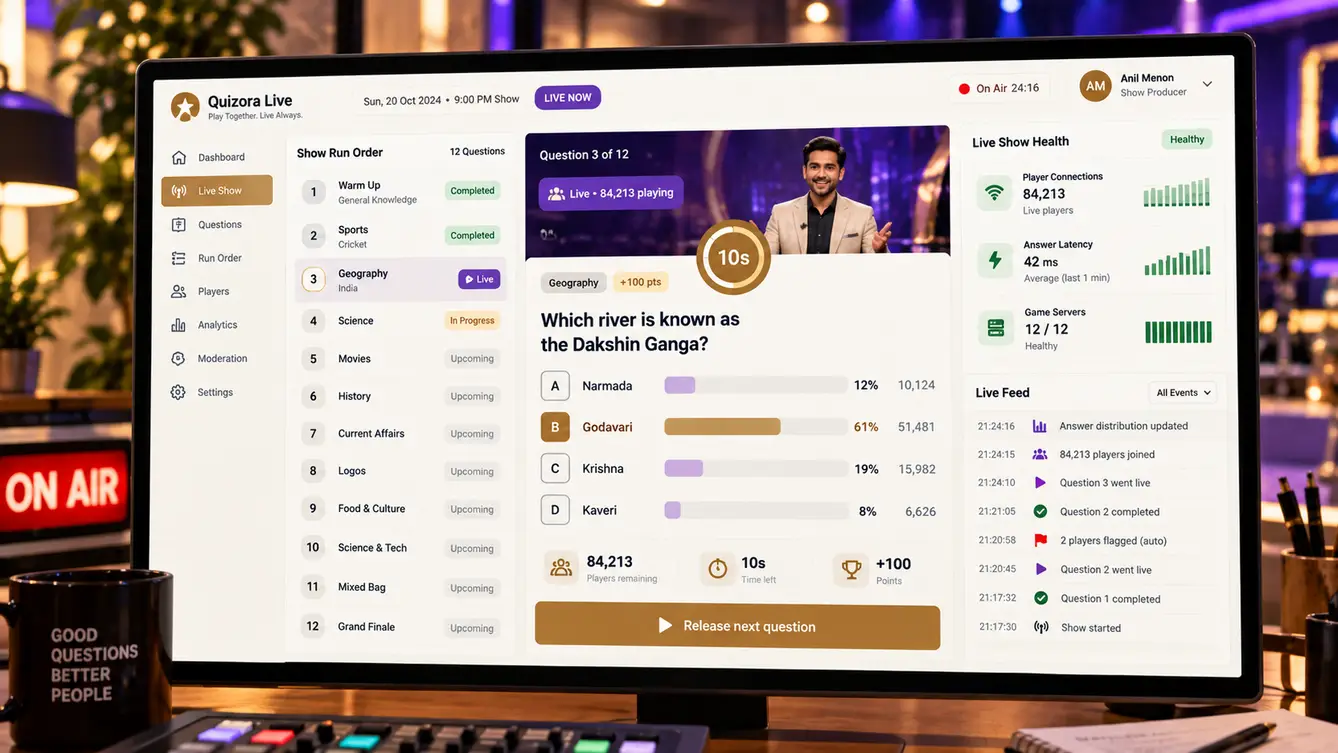
The first live show
The first show ran after a week of rehearsal shows with invited players. On launch night the team watched the dashboards through every question; the bursts came and went exactly as the load tests predicted.
- Weeks 1–2Discovery
Show format and failed prototype analysed.
- Weeks 3–5Engine design
Burst architecture designed and spiked.
- Weeks 6–13Build
Game app, engine, host studio and production tools.
- Weeks 14–17Load tests and rehearsals
Repeated load tests and invited rehearsal shows.
- Week 18First live show
Public launch.
What we learned
Engineer for the peak, not the average. The game's quiet moments were irrelevant; the ten-second bursts were everything.
Rehearse operations like the product. Show-night runbooks and rehearsals mattered as much as the code.
- Flutter
- Go real-time game servers
- Redis
- WebSockets
- PostgreSQL
- LLM question drafting with review
- Kubernetes on AWS