LabLoop: from home sample collection to report delivery, a diagnostic lab chain that stopped losing samples
A diagnostic lab chain offered home sample collection across the city, but samples were mislabelled, phlebotomists arrived late and reports went out by email hours after they were ready. We built LabLoop: slot booking, phlebotomist routing, barcode-tracked samples from home to analyser, a laboratory information system and instant report delivery with doctor-friendly summaries.
A mislabelled tube
LabLoop's medical director told us about a patient whose sample had been labelled with another patient's name during a busy morning of home collections. It was caught — but it shook the whole team. Labels were handwritten, samples travelled in cool boxes with paper lists, and nobody could say exactly where a given tube was at any moment.
Customers had their own frustrations: phlebotomists arriving outside their booked slot, and reports arriving by email long after they were ready.
“A lab's first job is to be sure the result belongs to the right person.”
Following a sample
We followed samples from booking to report: slot allocation by phone, a phlebotomist with a paper route, handwritten labels, a courier handover, manual entry at the lab, analysers producing results that were typed into reports. Every hand-off was a chance for error or delay.
- Handwritten labels at the patient's home
- Paper routes and missed slots
- Manual entry of samples and results
- Reports emailed in batches
A barcode from the first minute
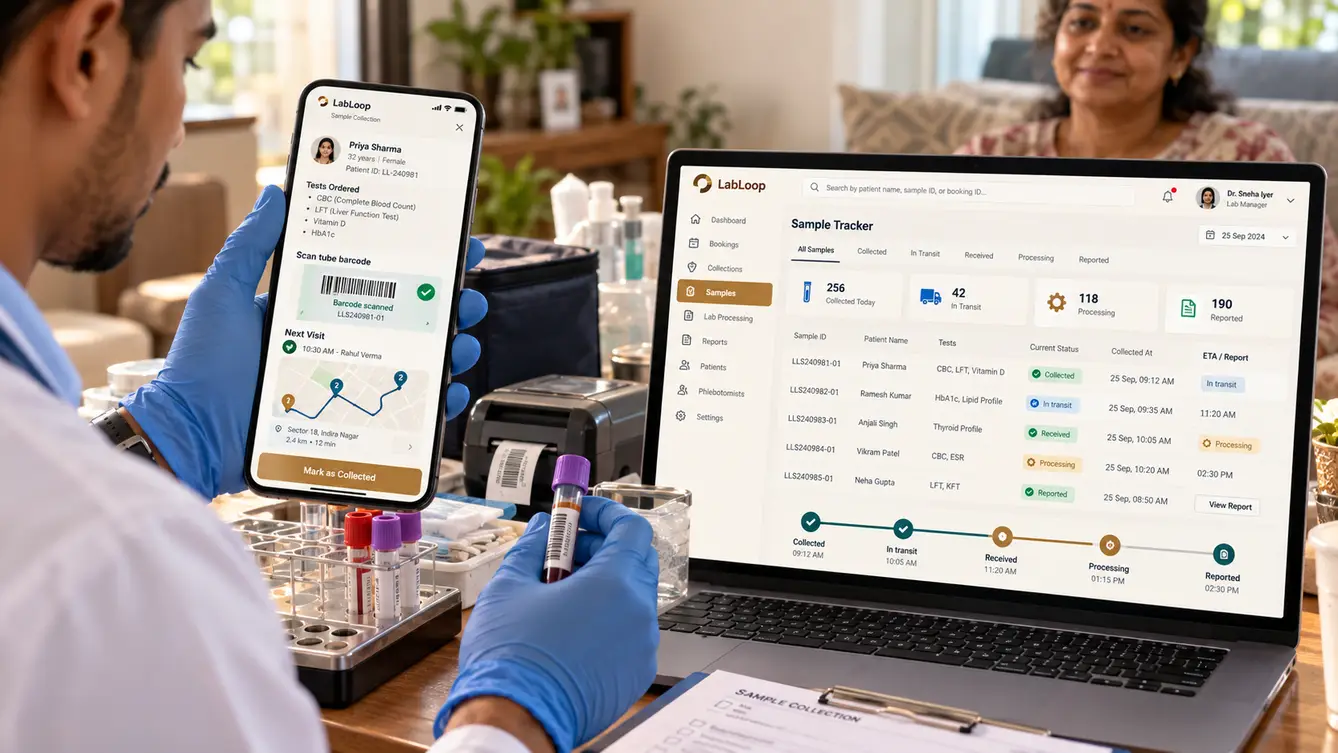
In LabLoop, each booking generates barcoded labels printed on a portable printer at the patient's home. The phlebotomist scans each tube against the booking before drawing blood. From then on, every step — handover, receipt at the lab, analyser run — is a scan, and results flow directly from analysers into the report.
Routes are optimised across bookings so phlebotomists arrive within slot. Reports are released the moment a pathologist signs them, to the patient's app and their doctor's portal.
The team
Analyser integration needed an engineer experienced with laboratory interfaces.
Lab workshops and zone rollout.
Patient, phlebotomist and lab experiences.
Patient and phlebotomist apps.
Lab system and doctor portal.
Analyser interfaces and label printing.
7 people in total, working as one team.
Decisions we made
Agreed with the medical director and operations head.
When to label samples?
- At the lab
- At the patient's home with printed barcodes
Our call: At the patient's home with printed barcodes. Labelling at the source removed the chance of mix-ups in transit.
Manual or interfaced results?
- Technicians type results
- Results directly from analysers
Our call: Results directly from analysers. Interfacing removed transcription errors and saved time.
Email or instant reports?
- Batch emails
- Instant release to app and doctor portal
Our call: Instant release to app and doctor portal. Patients and doctors got results the moment they were validated.
Every feature, module by module
Everything that shipped for patients, phlebotomists, the lab and doctors.
- 01Test and slot booking
Home collection or lab visit slots.
- 02Phlebotomist tracking
Arrival time and live location.
- 03Instant reports
Reports in the app when released.
- 04Report trends
Results compared with past tests.
- 05Online payments
Prepaid or pay at collection.
- 06Optimised routes
Visits sequenced to meet slots.
- 07Barcode label printing
Labels printed at the patient's home.
- 08Tube scan verification
Each tube matched to the booking.
- 09Handover scans
Chain of custody to the lab.
- 10Sample receipt
Scan-in at the lab with condition checks.
- 11Analyser interfacing
Results directly from instruments.
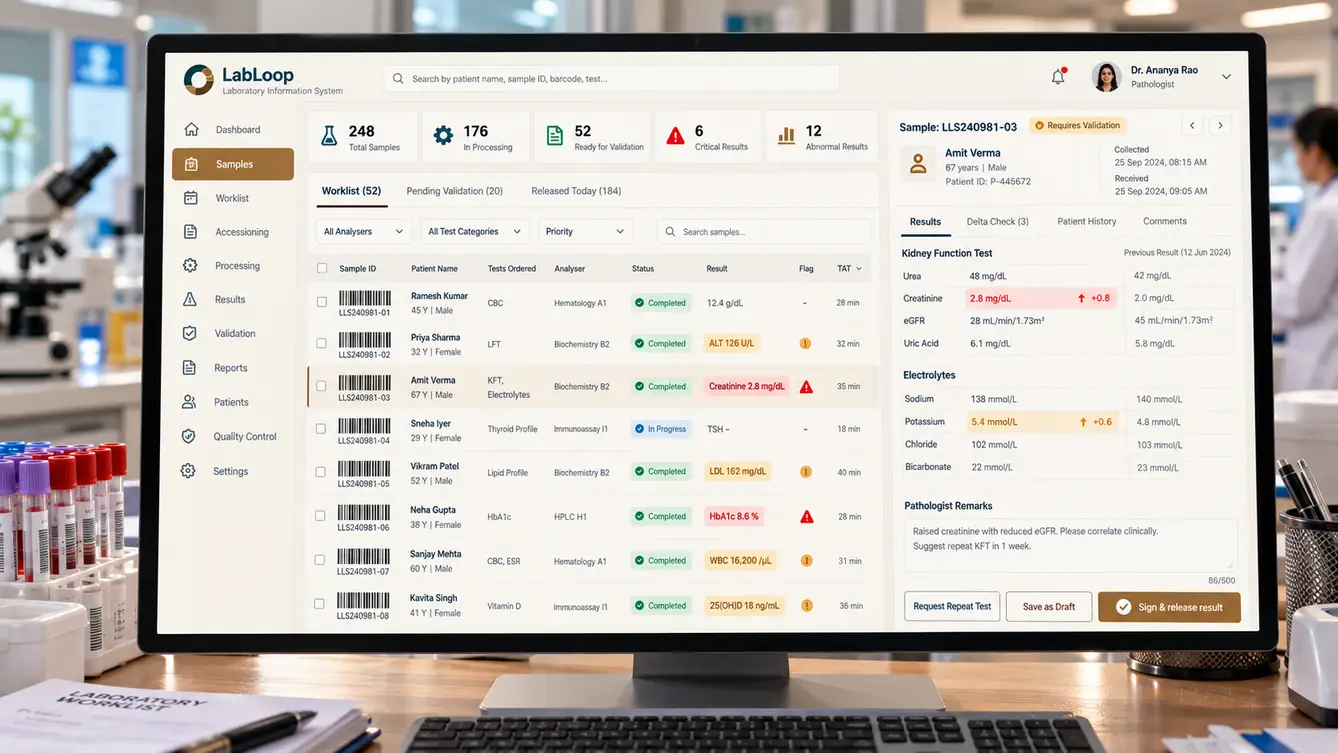
- 12Worklists
Samples by section and priority.
- 13Validation and delta checks
Comparison with previous results.
- 14Critical value alerts
Urgent results flagged for action.
- 15Pathologist sign-off
Digital signature before release.
- 16Doctor portal
Referred patients' reports.
- 17Sample tracking dashboard
Every sample's location and stage.
- 18Turnaround monitoring
Report times by test and zone.
- 19Role-based access
Patients, phlebotomists, lab staff and doctors.
- 20Audit trail
Every scan and result change recorded.
Rollout
We started with home collections in one zone and the central lab, then extended to all zones and satellite labs. Analysers were interfaced one by one, with results double-checked against manual entry until each matched perfectly.
- Weeks 1–3Discovery
Samples followed from booking to report.
- Weeks 4–5Design
Barcoding flow and apps prototyped.
- Weeks 6–15Build
Apps, lab system and analyser interfaces.
- Weeks 16–18Zone pilot
One zone and the central lab.
- Weeks 19–20All labs
All zones and satellite labs.
What we learned
Identify at the source. Barcoding at the patient's door eliminated the most dangerous class of error.
Remove typing wherever possible. Analyser interfacing ended transcription errors in results.
- React Native
- Next.js
- NestJS
- PostgreSQL
- Barcode and label printing
- Analyser interfacing (HL7 / ASTM)
- Route optimisation
- Private cloud