ColdWatch: IoT cold-chain monitoring that catches a failing freezer before the stock is lost
A cold-chain logistics company stored and moved vaccines, dairy and frozen food, and discovered temperature excursions only when a clerk checked a paper log or a customer complained. We built ColdWatch: wireless temperature sensors, a gateway that survives power cuts, real-time alerts with escalation, compressor-failure prediction and compliance reports — 24 features that watch every cold room and truck around the clock.
A weekend and a freezer
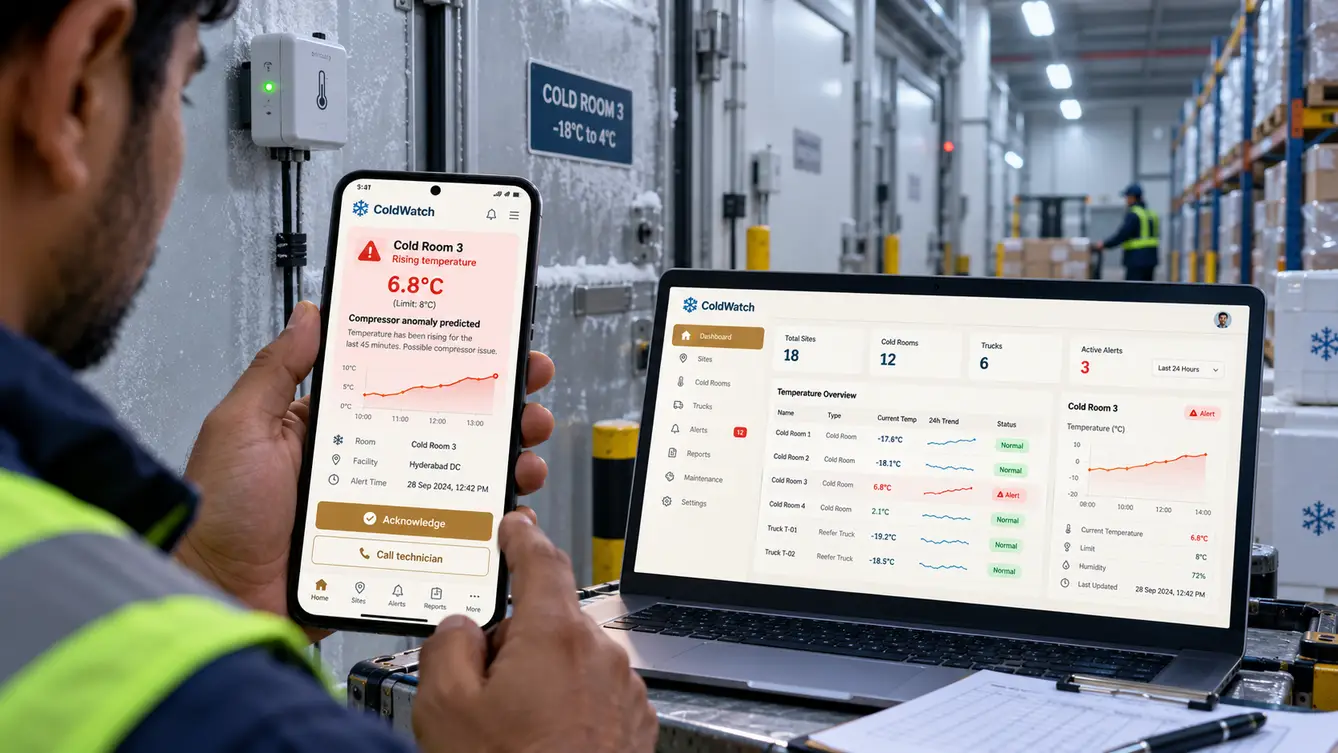
ColdWatch's operations director told us about a Monday morning: a cold room's compressor had failed on Saturday night, the temperature had drifted up for more than a day, and an entire consignment of frozen product had to be written off. The paper temperature log showed readings every four hours on weekdays — and nothing on Sunday.
For vaccine customers, the stakes were higher still: excursions had to be detected, documented and reported, and the company's contracts depended on proving temperature control.
“We don't lose stock because we're careless. We lose it because nobody is watching at 3 a.m.”
Surveying the cold chain
We surveyed cold rooms, blast freezers and refrigerated trucks across the company's facilities. Wi-Fi did not penetrate insulated rooms, power cuts were common, and trucks travelled through areas with no signal. Any system that depended on constant connectivity would fail exactly when it was needed.
- Insulated rooms that block Wi-Fi
- Frequent power cuts
- Trucks travelling through no-signal areas
- Customers requiring auditable temperature records
Designed to keep working when things fail
Sensors use low-power long-range radio that passes through insulated walls and lasts years on a battery. Each facility has a gateway with battery backup and a 4G connection; if connectivity drops, readings are stored and uploaded later with their original timestamps. Truck sensors log continuously and upload whenever the truck has signal.
Alerts escalate: a warning to the shift supervisor, then the facility manager, then the operations director, by app notification, SMS and an automated voice call until someone acknowledges. A model watching temperature cycles flags compressors that are starting to struggle, often hours before an excursion.
The team
Hardware, connectivity and data expertise were all essential, so the team combined an IoT engineer with data and app engineers.
Facility surveys and installation schedule.
Sensors, gateways, radio planning and installation.
Time-series pipeline and compliance records.
Dashboard, customer portal and reports.
Alert and response app.
Compressor anomaly detection.
6 people in total, working as one team.
Decisions we made
Agreed with the operations director and quality head.
Wi-Fi or long-range radio sensors?
- Wi-Fi sensors
- LoRaWAN sensors with facility gateways
Our call: LoRaWAN sensors with facility gateways. Wi-Fi does not pass through insulated walls reliably; long-range radio does, and batteries last years.
What happens during outages?
- Readings lost
- Battery-backed gateways with store-and-forward
Our call: Battery-backed gateways with store-and-forward. Excursions often start during power cuts. Buffered readings kept records complete.
Single notification or escalation?
- One push notification
- Escalation across app, SMS and voice until acknowledged
Our call: Escalation across app, SMS and voice until acknowledged. A single notification at 3 a.m. can be missed. Escalation ensured someone responded.
Fixed thresholds only?
- Threshold alerts
- Thresholds plus anomaly prediction
Our call: Thresholds plus anomaly prediction. Thresholds catch problems; anomaly detection catches failing equipment before products are at risk.
The 24 features
Everything that shipped from sensors to compliance reports.
- 01Wireless temperature sensors
Long-range, battery-powered sensors.
- 02Humidity and door sensors
Where products require them.
- 03Battery-backed gateways
Keep working through power cuts.
- 04Store-and-forward
Readings buffered and uploaded later.
- 05Truck logging
Continuous logging in transit.
- 06Threshold alerts
Product-specific temperature limits.
- 07Escalation chains
App, SMS and voice until acknowledged.
- 08Acknowledgement and actions
Response recorded with corrective actions.
- 09Compressor anomaly prediction
Failing equipment flagged early.
- 10Sensor health alerts
Low battery and offline sensors.
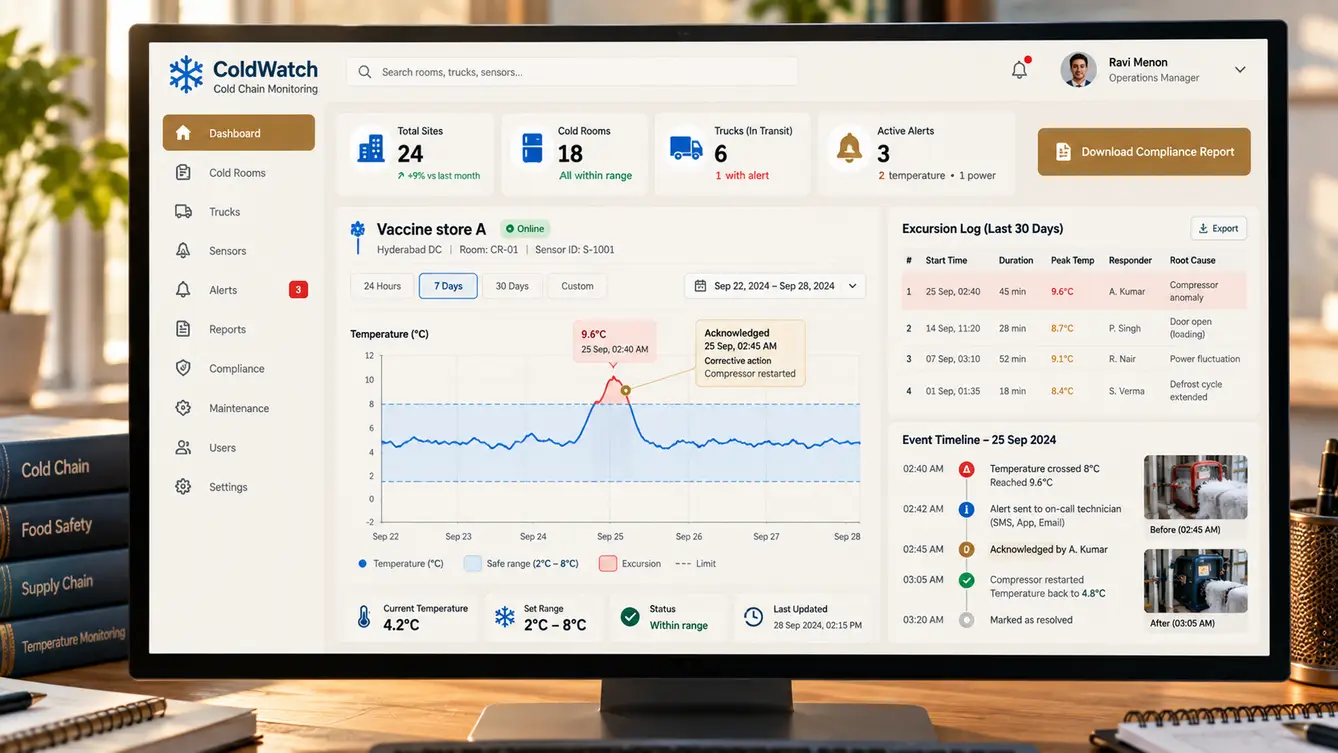
- 11Live dashboard
All facilities and trucks with current readings.
- 12Temperature history
Charts for any sensor and period.
- 13Shipment temperature records
Temperature history per consignment.
- 14Facility maps
Sensors placed on room layouts.
- 15Compliance reports
Continuous records with excursions documented.
- 16Customer portal
Customers view their products' temperature records.
- 17Excursion log
Duration, peak and response for every event.
- 18Calibration records
Sensor calibration tracked.
- 19Immutable records
Readings cannot be edited.
- 20Role-based access
Supervisors, managers, quality and customers.
- 21Data export
Records exported for audits.
- 22Maintenance tickets
Equipment issues sent to technicians.
- 23Energy insights
Compressor duty cycles and energy use.
- 24Multi-facility management
All sites in one console.
Rollout
Sensors were installed facility by facility over a few weeks, each with a two-week burn-in where alerts went only to our team so thresholds could be tuned before waking anyone at night. The first real alert came from a cold room whose door had been left ajar; it was closed within minutes.
- Weeks 1–2Facility survey
Cold rooms and trucks surveyed for signal and power.
- Weeks 3–4Design
Sensor, gateway and alert design.
- Weeks 5–11Build
Pipeline, dashboard, app, portal and anomaly model.
- Weeks 12–14Installation and burn-in
Sensors installed; thresholds tuned.
- Weeks 15–16Live monitoring
All facilities and trucks live.
What we learned
Design for failure first. Battery backup and store-and-forward were the most important features, because excursions often happen during outages.
Tune alerts before trusting them. The burn-in period avoided alert fatigue from day one.
- LoRaWAN temperature sensors
- Edge gateways with battery backup and 4G
- MQTT
- TimescaleDB
- Next.js
- React Native
- Anomaly detection model
- AWS Mumbai