
BotYard: one control system for a warehouse running robots from three different makers
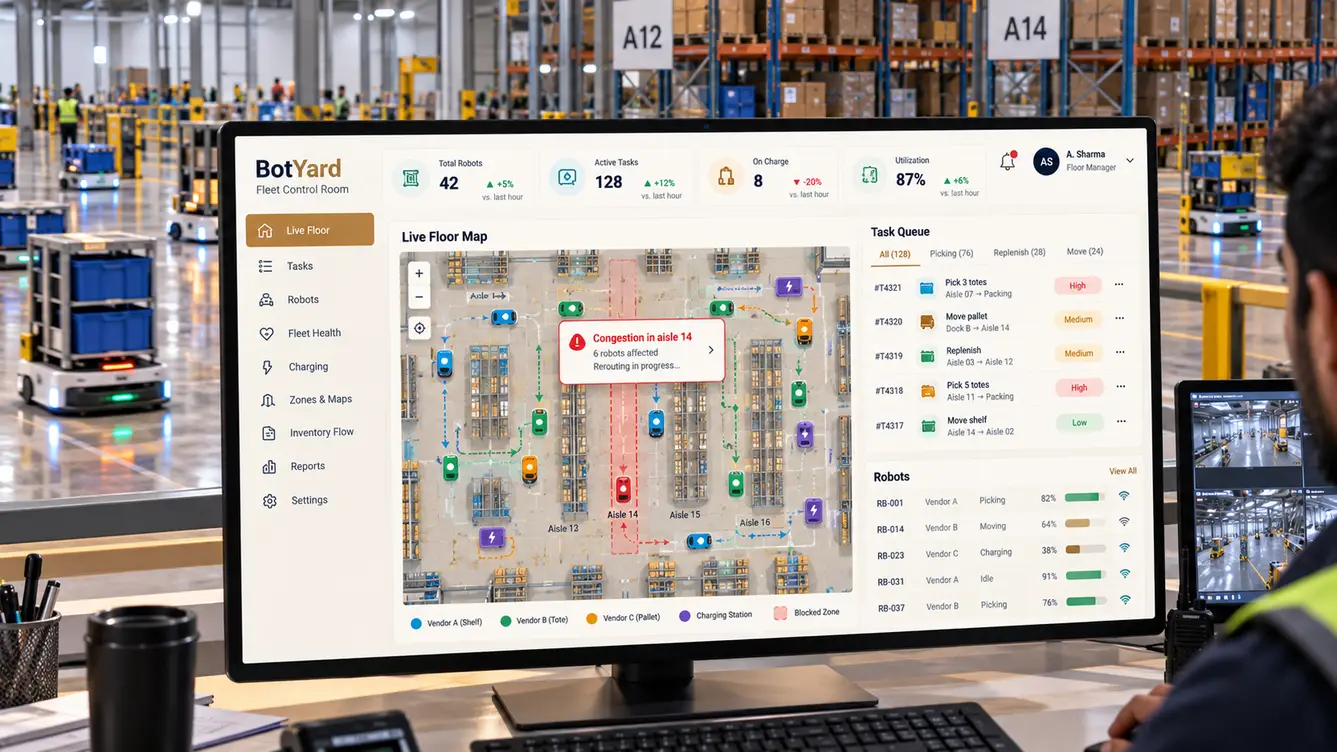
A third-party logistics company had introduced autonomous mobile robots in its largest warehouse — from three different manufacturers, each with its own software. Robots blocked each other, tasks were assigned by hand and nobody could see the whole floor. We built BotYard: a unified fleet manager, task orchestration from the warehouse system, traffic management, charging scheduling and live floor visualisation.
Three robot fleets that didn't talk
BotYard's head of automation had bought robots from three manufacturers, each best at something different: goods-to-person shelves, tote carriers and pallet movers. Each came with its own fleet software. Robots from different vendors blocked each other in shared aisles, and supervisors assigned work across three screens by hand.
“We bought robots to reduce manual work. We ended up manually managing robots.”
Watching the floor
We spent shifts on the warehouse floor and in the control room. Congestion happened at predictable points — shared aisles and charging stations. Robots charged at the worst times because each fleet scheduled charging independently. The warehouse management system released work without knowing which robots were available.
- Robots from different vendors blocking shared aisles
- Charging scheduled independently per fleet
- Work assigned manually across three screens
- No single view of the floor
One brain above three fleets
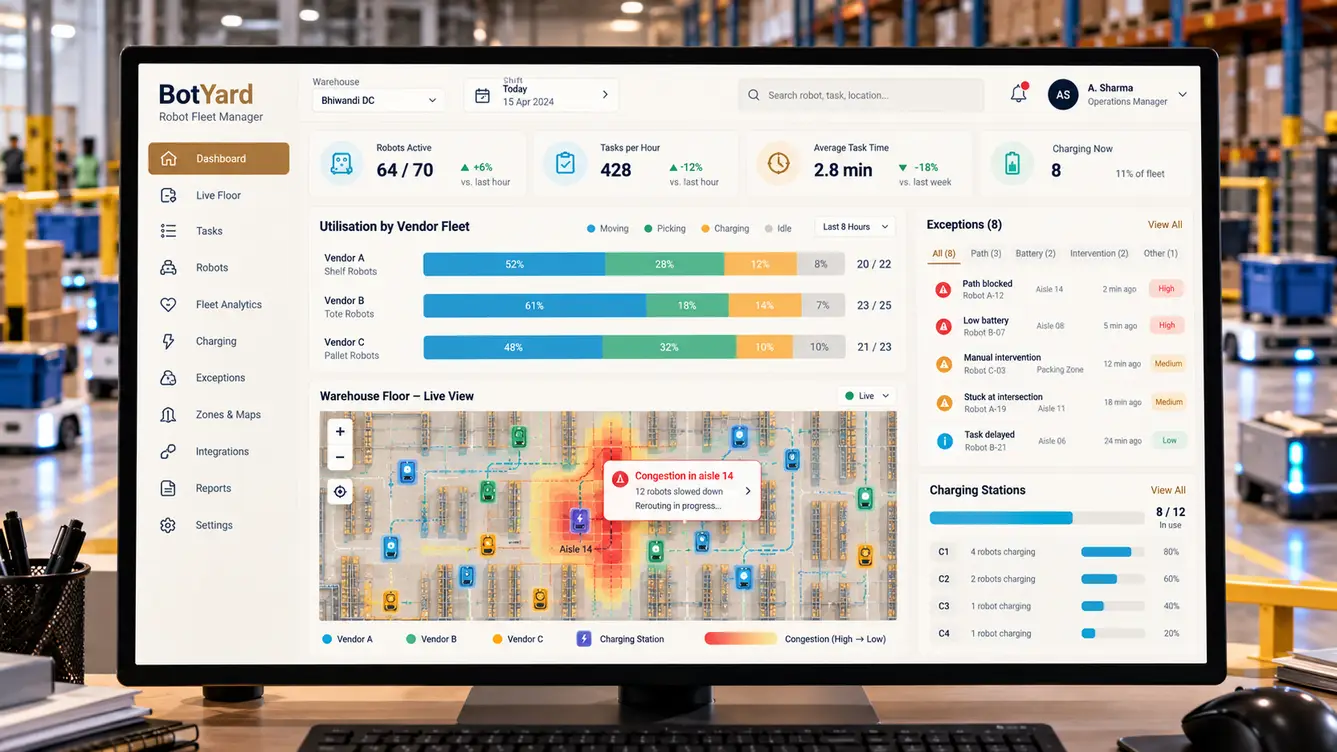
BotYard sits above the vendor systems, talking to each through adapters and open standards where supported. It receives work from the warehouse management system and assigns tasks to the best available robot from any fleet. A traffic manager reserves shared zones so robots from different vendors never contest the same aisle, and charging is scheduled across the whole floor around demand peaks.
Supervisors see every robot live on one map and handle exceptions — blocked paths, faults, manual interventions — from a tablet.
The team
Real-time systems and robotics integration experience led the team.
Floor observation and vendor coordination.
Control room map and supervisor app.
Orchestration, traffic and charging scheduling.
Vendor adapters and standards.
Telemetry and fleet analytics.
6 people in total, working as one team.
Decisions we made
Agreed with the head of automation and robot vendors.
Replace vendor software or sit above it?
- Replace vendor fleet software
- Orchestrate above it through adapters
Our call: Orchestrate above it through adapters. Vendors' low-level navigation worked well; BotYard coordinated across fleets without replacing it.
How to avoid congestion?
- Let each fleet navigate independently
- Reserve shared zones across fleets
Our call: Reserve shared zones across fleets. Zone reservation prevented cross-vendor blocking.
Cloud or edge?
- Cloud orchestration
- On-premise edge servers
Our call: On-premise edge servers. Robot coordination needs low latency and must work without internet.
Every feature, module by module
Everything that shipped for the control room, supervisors and integration.
- 01WMS integration
Work received from the warehouse system.
- 02Cross-fleet task assignment
Best available robot from any vendor.
- 03Priorities and deadlines
Urgent orders first.
- 04Vendor adapters
Each fleet connected through adapters.
- 05Open standard support
VDA 5050 where supported.
- 06Zone reservation
Shared aisles reserved across fleets.
- 07Rerouting
Paths adjusted around congestion.
- 08Charging scheduling
Planned around demand peaks.
- 09Battery monitoring
Levels across every robot.
- 10Live floor map
Every robot, path and task.
- 11Exception handling
Faults and blocked paths flagged.
- 12Supervisor tablet app
Handle exceptions on the floor.
- 13Manual override
Pause, redirect or remove robots.
- 14Fleet utilisation
By vendor and zone.
- 15Throughput analytics
Tasks per hour and cycle times.
- 16Congestion heatmaps
Where robots wait.
- 17Telemetry storage
Time-series data for every robot.
- 18Role-based access
Operators, supervisors and engineers.
- 19Audit trail
Overrides and interventions recorded.
Rollout
BotYard took control of one zone first, with vendor systems still running underneath. Once traffic management and task assignment proved themselves, control extended zone by zone to the full floor.
- Weeks 1–3Discovery
Floor shifts and vendor system review.
- Weeks 4–6Design
Orchestration, traffic and control room.
- Weeks 7–16Build
Adapters, orchestration, traffic and analytics.
- Weeks 17–19First zone
BotYard controls one zone.
- Weeks 20–22Full floor
Zone-by-zone expansion.
What we learned
Orchestration beats individual optimisation. Coordinating fleets did more than improving any one of them.
Adopt standards where they exist. Open interfaces made adding new robots easier.
- Next.js
- Go orchestration services
- MQTT
- PostgreSQL
- TimescaleDB
- VDA 5050 and vendor APIs
- Real-time floor map
- On-premise edge servers