
ClaimSetu: turning a motor insurance claim from a two-week phone saga into a guided, photo-first journey
A general insurer's motor claims ran on phone calls, emailed photos and surveyors juggling spreadsheets. We built ClaimSetu: a policyholder app for first notice of loss, a surveyor app for inspections, a garage portal and a claims desk with AI damage triage and fraud signals — 26 features that cut the back-and-forth out of every claim.
It started with a complaint log
ClaimSetu's head of claims sent us something unusual before our first meeting: an export of six months of customer complaints. More than half were about motor claims, and almost none were about the settlement amount. They were about not knowing what was happening — "I sent the photos twice", "the surveyor never called", "the garage says they are waiting for you".
Behind every complaint was the same pattern. A claim started with a phone call, then moved through email, WhatsApp, a surveyor's personal phone and a garage's paper job card. Each hand-off lost information, and every missing piece meant another call to the policyholder.
“We pay most claims fairly. We just make people chase us for it.”
Mapping one claim across four parties
In discovery we followed live claims with the claims team's permission: a minor bumper dent, a windscreen replacement and a larger collision. We sat with a surveyor on inspections and spent a morning in a partner garage. Four parties touched every claim — the policyholder, the claims handler, the surveyor and the garage — and none of them could see what the others had done.
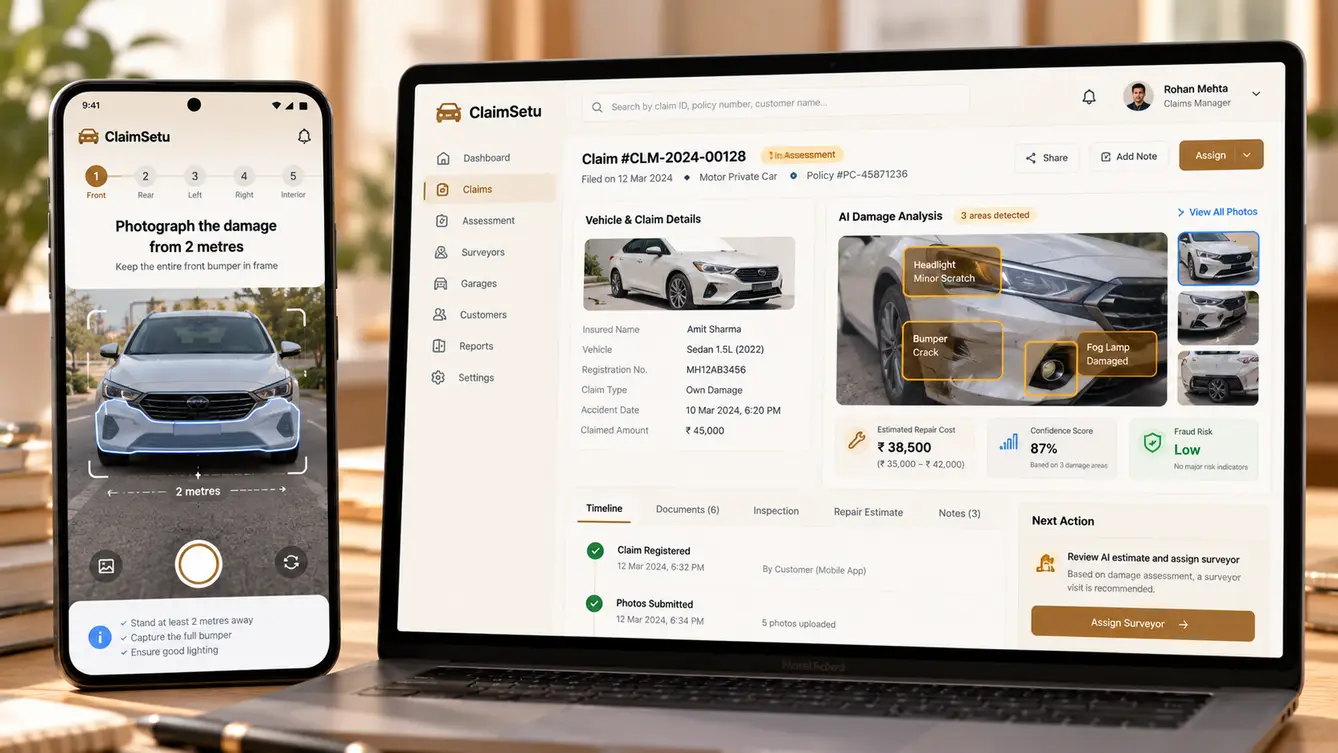
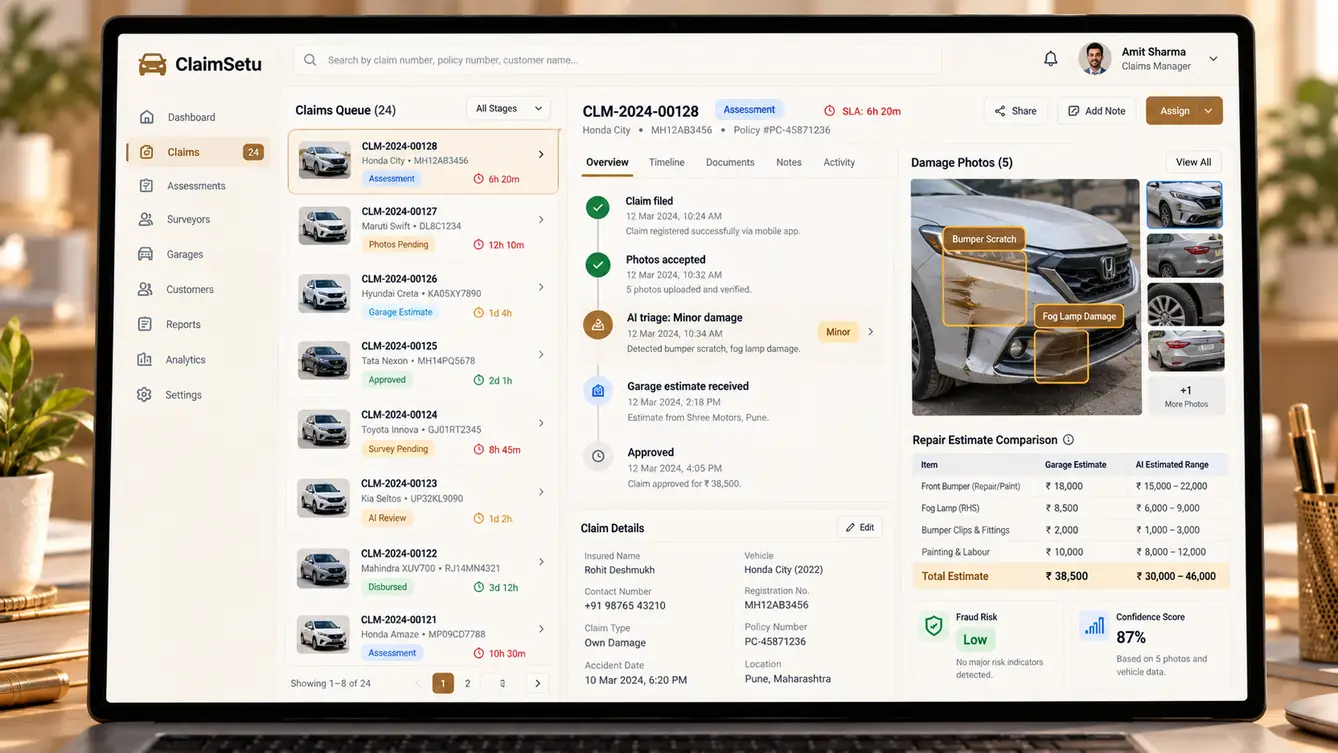
The design principle that came out of this was simple: one claim, one timeline, visible to everyone with a role in it. Each party would see the parts relevant to them, and every action would appear on the shared timeline automatically.
- Unusable photos: too close, too dark or the wrong panel
- Surveyor scheduling done over personal phone calls
- Garage estimates emailed as scanned paper
- Policyholders unable to see status without calling
Designing a photo-first claim
The most important screen in ClaimSetu is the camera. Most delays started with poor photos, so we built a guided capture flow: an outline of the car shows which angle to take next, the app checks each photo for blur, distance and lighting before accepting it, and it records the time and location automatically.
For minor damage, those photos go straight to an AI damage triage model that identifies the affected panels and suggests whether a physical survey is needed at all. Clear, low-value claims can be assessed on photos alone; anything larger or ambiguous goes to a surveyor with the photos already attached.
The team
ClaimSetu needed mobile, computer vision and enterprise workflow skills in equal measure, so the team was built around three small pods that shared one backlog and one weekly demo with the claims leadership.
Claims and compliance workshops, pilot planning and rollout.
Guided camera flow, claim timeline and the claims desk.
Policyholder and surveyor apps with offline capture.
Claims desk and garage portal.
Claim workflow, policy system integration and notifications.
Damage triage model, photo quality checks and fraud signals.
Device testing, claim scenarios and model regression checks.
9 people in total, working as one team.
Five decisions that defined the product
Insurance mixes customer experience, fraud risk and regulation. These were the decisions we took with the claims and compliance teams before building.
Should AI approve claims automatically?
- Auto-approve low-value claims
- AI recommends a route, humans decide
Our call: AI recommends a route, humans decide. Settlement decisions carry regulatory and customer consequences. The model routes claims and highlights damage; a handler makes every decision, with the AI's reasoning visible.
Where to check photo quality?
- Server-side after upload
- On the device before accepting each photo
Our call: On the device before accepting each photo. Rejecting a blurry photo at the roadside, while the car is still there, avoids a callback days later. On-device checks also save upload data on weak networks.
Build a garage app or a web portal?
- Native garage app
- Lightweight web portal usable on any device
Our call: Lightweight web portal usable on any device. Garages work across many insurers and will not install one app per insurer. A web portal opened from a WhatsApp link removed that barrier entirely.
How explainable should fraud signals be?
- A single risk score
- Individual signals with reasons
Our call: Individual signals with reasons. A bare score invites either blind trust or blanket distrust. Showing each signal and its reason lets handlers judge context and keeps decisions defensible.
Integrate with the policy admin system or copy data?
- Nightly data copy
- Live API integration for policy and cover checks
Our call: Live API integration for policy and cover checks. Cover must be checked against the current policy at the moment a claim is filed. Live integration avoided claims being accepted against lapsed or changed policies.
Everything ClaimSetu does
Twenty-six features across four products, all sharing one claim record and one timeline.
- 01Instant claim filing
Start a claim in minutes with policy details pre-filled.
- 02Guided damage camera
Angle-by-angle guidance with blur and distance checks.
- 03Live claim tracker
Every stage, owner and next step, in plain language.
- 04Garage selection
Choose a network garage by distance and rating.
- 05Document upload
Licence, registration and FIR captured with OCR.
- 06Settlement and payout status
Approved amount, deductions and payment confirmation.
- 07Inspection scheduling
Assigned surveys with routes and customer contact.
- 08Structured survey report
Panel-by-panel assessment with photos.
- 09Offline inspections
Capture everything without signal; sync later.
- 10Estimate comparison
Garage estimate side by side with parts price lists.
- 11Estimate submission
Itemised estimates with parts and labour.
- 12Approval notifications
Approvals and queries delivered by WhatsApp link.
- 13Repair progress updates
Photo updates as repairs progress.
- 14Invoice and payment tracking
Final invoice upload and payment status.
- 15Damage triage
Detect affected panels and recommend photo or physical survey.
- 16Photo quality scoring
Reject unusable photos before they cause delays.
- 17Fraud signals
Location, metadata and repeat-vehicle checks with reasons.
- 18Repair cost range
Expected cost band from historical claims for comparison.
- 19Claims queue with SLAs
Prioritised work queues with turnaround timers.
- 20Shared claim timeline
Every action by every party, in order.
- 21Policy and cover checks
Live validation against the policy admin system.
- 22Approval hierarchy
Limits-based approvals with audit trail.
- 23Customer communication
Templated SMS, email and WhatsApp updates.
- 24Claims analytics
Turnaround, routes, costs and garage performance.
- 25Audit and compliance log
Complete record for internal audit and regulators.
- 26Role-based access
Separate permissions for handlers, surveyors and garages.
Building and proving the AI
We trained and evaluated the damage triage model on historical claim photos provided by ClaimSetu, labelled with the panels and repair decisions surveyors had actually made. The model never approves a claim on its own; it recommends a route — photo assessment or physical survey — and handlers can always override it.
The fraud signals were deliberately simple and explainable: photos taken far from the reported location, the same vehicle appearing in multiple recent claims, image metadata that did not match the claim date. Each signal shows its reason so a handler can judge it.
- Weeks 1–3Discovery
Complaint analysis, live claims followed, surveyor and garage visits.
- Weeks 4–6Design
Guided camera and shared timeline prototyped and tested with policyholders.
- Weeks 7–15Build
Four products and the triage model built in parallel pods.
- Weeks 16–18Pilot
Minor motor claims in two cities.
- Weeks 19–22National rollout
All motor claims, garage network onboarded.
Launch and what changed
ClaimSetu launched first for minor motor claims in two cities, then expanded to all motor claims nationally. The claims team's favourite change was not the AI — it was that policyholders stopped calling to ask for status, because they could see it.
Garages adopted the portal faster than expected once they realised approved estimates came back the same day instead of waiting for an email chain.
What we learned
Better inputs beat smarter models. The guided camera did more to speed up claims than any model improvement, because it removed the most common reason for going back to the customer.
Shared visibility changes behaviour. When the garage, surveyor and handler all see the same timeline, delays become visible — and visible delays get fixed.
- React Native
- Next.js
- Node.js / NestJS
- PostgreSQL
- Computer vision damage model
- Document OCR
- AWS Mumbai