
CashlessOne: cutting the wait at the hospital discharge desk for health insurance patients
Patients with health insurance often waited hours at discharge while hospitals, the insurer's claims administrator and doctors exchanged emails about approvals. We built CashlessOne for a claims administrator: a hospital portal for pre-authorisation, AI document reading, rules-based medical review, live status for patients and discharge approvals — so families spend less time at the desk and more time going home.
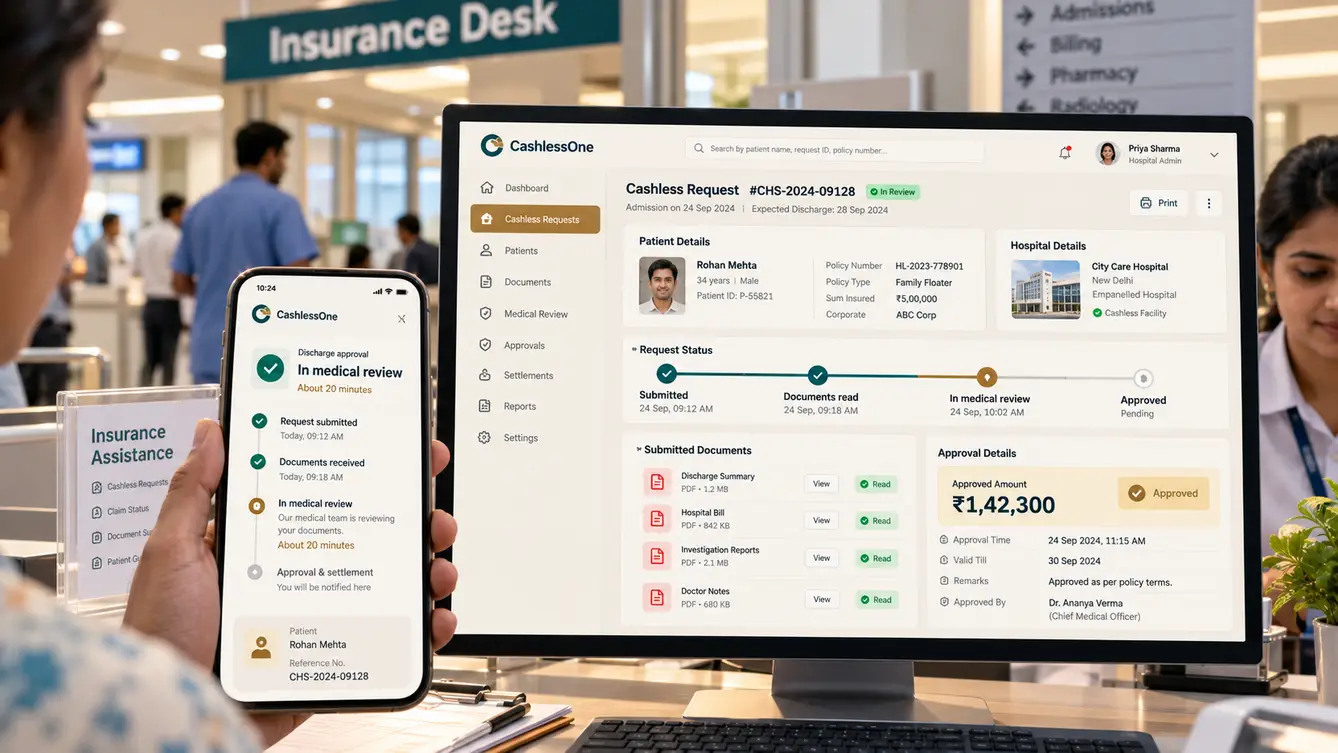
Six hours at the discharge desk
CashlessOne's chief operating officer described a common scene: a patient is medically fit to go home in the morning, but the family waits until evening while the hospital's insurance desk emails the discharge summary, the claims team asks for a missing document, and a doctor reviews it when they get to it.
The claims administrator processed requests from many hospitals, arriving by email, fax and portals, in every format imaginable. Reviewers spent much of their time finding information in documents before they could make any decision.
“Nobody should spend their last day in hospital waiting for an email.”
Following a request
We followed cashless requests from hospital desk to approval. The pattern was consistent: incomplete submissions, manual reading of documents, repeated back-and-forth for missing items, and no visibility for hospitals or families about where a request stood.
- Incomplete submissions from hospitals
- Reviewers searching documents for key facts
- Back-and-forth over email for missing items
- No status visibility for hospitals or families

Complete in, clear out
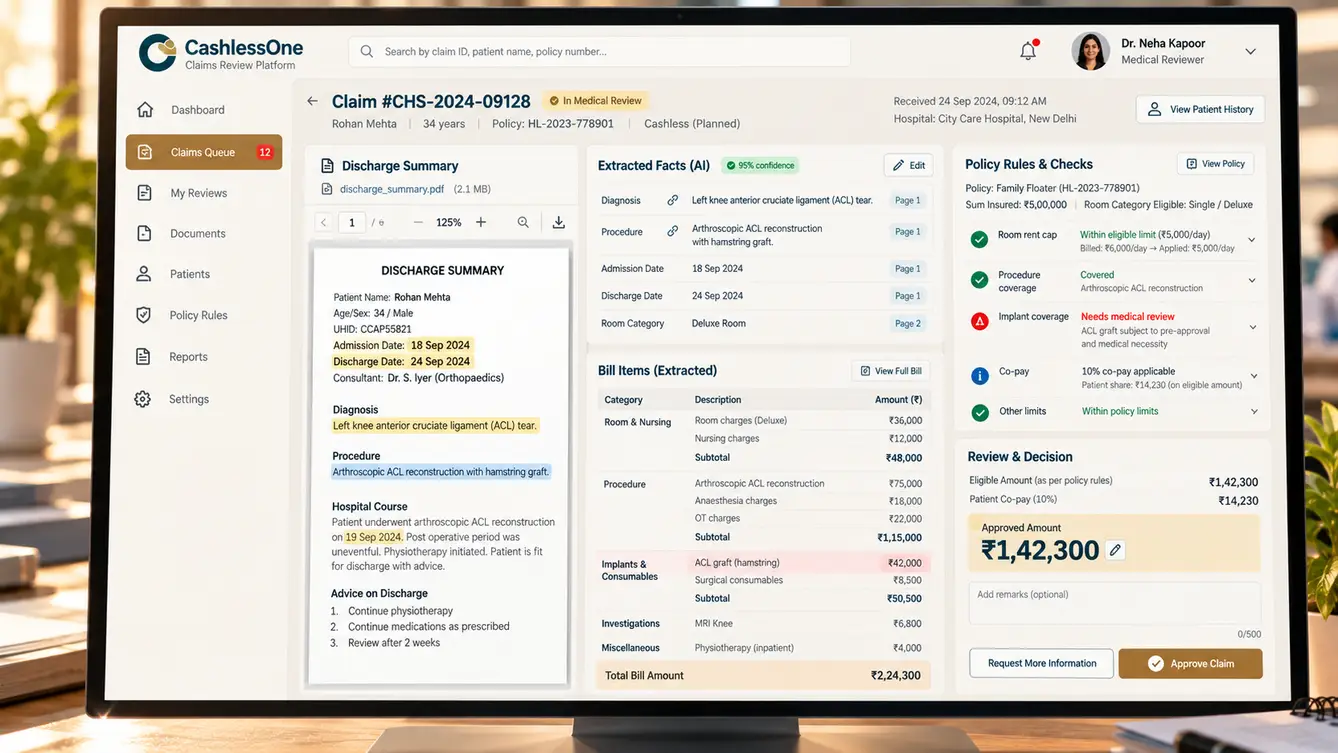
The hospital portal checks submissions for completeness before they are sent, based on the procedure and policy. AI extracts diagnoses, procedures, dates and bill items from documents and presents them to reviewers alongside the policy terms, with each fact linked to its place in the document.
A rules engine applies policy limits, room-rent caps and exclusions automatically and highlights anything needing medical judgement. Doctors on the review team make the medical decision; everything else is prepared for them.
The team
A medical advisor worked with the team to encode policy rules and review AI extraction quality.
Operations workshops and hospital onboarding.
Policy rules and extraction quality review.
Hospital portal and review console.
Medical document extraction and evaluation.
Portal, rules engine and integrations.
7 people in total, working as one team.
Decisions we made
Agreed with the COO, the medical head and the compliance team.
Should AI approve claims?
- Auto-approve simple claims
- AI prepares; doctors and processors decide
Our call: AI prepares; doctors and processors decide. Medical decisions carry patient and regulatory consequences. AI speeds up preparation only.
How to handle incomplete submissions?
- Request missing items after review
- Check completeness before submission
Our call: Check completeness before submission. Catching gaps at the hospital desk removed the most common cause of delay.
How to encode policy terms?
- Reviewers remember terms
- Rules engine for limits, caps and exclusions
Our call: Rules engine for limits, caps and exclusions. Rules applied consistently and explained each deduction.
What should families see?
- Nothing
- A simple status link
Our call: A simple status link. Families only needed to know the stage and rough wait, which reduced desk queries.
Every feature, module by module
Everything that shipped for hospitals, reviewers, patients and insurers.
- 01Pre-authorisation requests
Structured requests with policy lookup.
- 02Completeness checks
Required documents by procedure.
- 03Discharge approvals
Final bill and summary submission.
- 04Query responses
Answer queries in the same thread.
- 05Status tracking
Live status for every request.
- 06Document extraction
Diagnoses, procedures, dates and bill items.
- 07Source highlighting
Each fact linked to the document.
- 08Policy rules engine
Limits, caps and exclusions applied.
- 09Medical review flags
Items needing clinical judgement.
- 10Approval workflow
Approvals by authority level.
- 11Patient status link
Simple status by SMS link.
- 12Insurer dashboards
Turnaround and approval metrics.
- 13Letters and notifications
Approval letters generated automatically.
- 14Email and fax ingestion
Requests from every channel in one queue.
- 15Work queues and SLAs
Prioritised by urgency and time.
- 16Hospital network management
Tariffs and agreements per hospital.
- 17Fraud and anomaly flags
Unusual billing patterns flagged.
- 18Role-based access
Hospitals, processors, doctors and insurers.
- 19Audit trail
Every decision and change recorded.
- 20Extraction quality monitoring
Accuracy tracked on reviewed cases.
Rollout across hospitals
We onboarded the busiest network hospitals first, training insurance desk staff in short sessions. Hospitals adopted the portal quickly once complete submissions came back approved faster.
- Weeks 1–3Discovery
Requests followed from desk to approval.
- Weeks 4–6Design and rules
Portal, console and policy rules.
- Weeks 7–15Build
Portal, extraction, rules engine and dashboards.
- Weeks 16–18Pilot hospitals
Busiest hospitals onboarded.
- Weeks 19–20Network rollout
Remaining network hospitals.
What we learned
Fix completeness at the source. Most delays started with a missing document.
Prepare decisions, don't make them. Doctors decided faster when facts and rules were laid out for them.
- Next.js
- Python / FastAPI
- PostgreSQL
- Medical document OCR and extraction
- Rules engine for policy terms
- Email and fax ingestion
- Private cloud