
Checkwise: building a field inspection SaaS from a founder's spreadsheet to paying customers in three countries
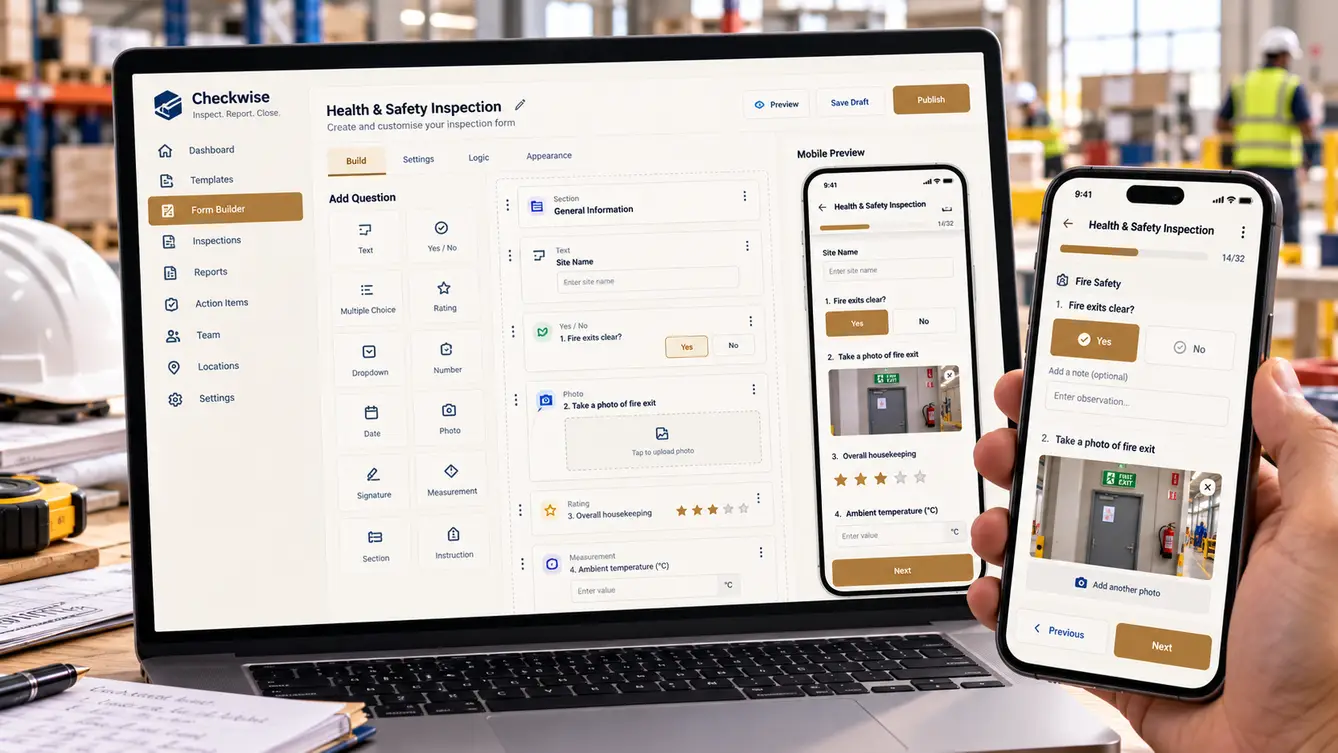
A founder who had run quality inspections for years wanted to turn his know-how into a SaaS product: configurable inspection forms, offline mobile inspections, photo evidence, automatic reports and corrective-action tracking. We built Checkwise from MVP to a multi-tenant product with billing, SSO and an API — 26 features and the architecture to keep adding more.
A founder with a spreadsheet and a clear pain
Checkwise's founder had spent a decade running supplier and site inspections for manufacturers and retailers. His inspectors used paper checklists, typed reports in the evening, and emailed PDFs that nobody followed up. He knew exactly what a better product should do; he needed a team to build it and a plan to turn it into a business.
His first request was ambitious: every feature from every competitor. Our first job was to find the smallest product customers would pay for.
“I know this job better than anyone. I just can't build the software.”
Finding the MVP
We interviewed five of the founder's former clients and three inspection managers. The common thread was not the checklist — it was what happened after it. Reports took hours to write and failed items were forgotten. The MVP became: build a form, run it offline with photos, get a professional report instantly, and track failed items to closure.
Everything else — analytics, integrations, scheduling — waited until customers asked for it with their wallets.
- In: form builder, offline inspections with photos, instant reports, corrective actions
- Waited: analytics, scheduling, integrations, white-labelling
- Rule: build what at least three customers would pay for

From MVP to a real SaaS
We built the MVP in twelve weeks on an architecture meant to grow: multi-tenant from day one with row-level security, a form definition format that could evolve without breaking old inspections, and an offline sync engine that handled conflicts deterministically.
The first paying customers arrived within weeks of launch. Their requests shaped v1: scheduling, analytics, SSO for enterprise clients, an API and branded reports — each added without reworking the foundation.
The team
A product-focused team that stayed with the founder from MVP through v1.
Customer interviews, MVP scope and roadmap with the founder.
Form builder, mobile inspection flow and reports.
Web app, multi-tenancy, billing and API.
Offline inspection app and sync engine.
Sync conflicts, report accuracy and regression tests.
6 people in total, working as one team.
Decisions we made
Made with the founder, balancing speed to market against a foundation that would last.
Everything at once or a focused MVP?
- Full feature list
- MVP built around the post-inspection pain
Our call: MVP built around the post-inspection pain. A focused MVP reached paying customers in weeks, and their feedback shaped v1.
Single-tenant or multi-tenant?
- Separate deployment per customer
- Multi-tenant with row-level security
Our call: Multi-tenant with row-level security. Multi-tenancy kept costs low and upgrades simple, with isolation enforced at the database.
How to version forms?
- Edit forms in place
- Versioned form definitions
Our call: Versioned form definitions. Editing a form must never change past inspections. Versioning kept history accurate.
When to build enterprise features?
- Up front
- When paying customers need them
Our call: When paying customers need them. SSO, API and branding were built when enterprise customers committed, avoiding speculative work.
The 26 features
Everything in Checkwise v1, from the MVP core to the enterprise features that followed.
- 01Drag-and-drop form builder
Questions, sections and logic without code.
- 02Question types
Yes/no, ratings, measurements, photos and signatures.
- 03Conditional logic
Show questions based on earlier answers.
- 04Scoring
Weighted scores and pass thresholds.
- 05Form versioning
Changes never alter past inspections.
- 06Template library
Ready-made inspection templates.
- 07Offline mobile inspections
Complete inspections without signal.
- 08Photo evidence and annotation
Capture and mark up photos.
- 09GPS and time stamps
Location and time recorded.
- 10Signatures
Inspector and site representative sign-off.
- 11Conflict-safe sync
Deterministic sync across devices.
- 12Instant PDF reports
Professional reports on completion.
- 13Branded reports
Customer logos and styles.
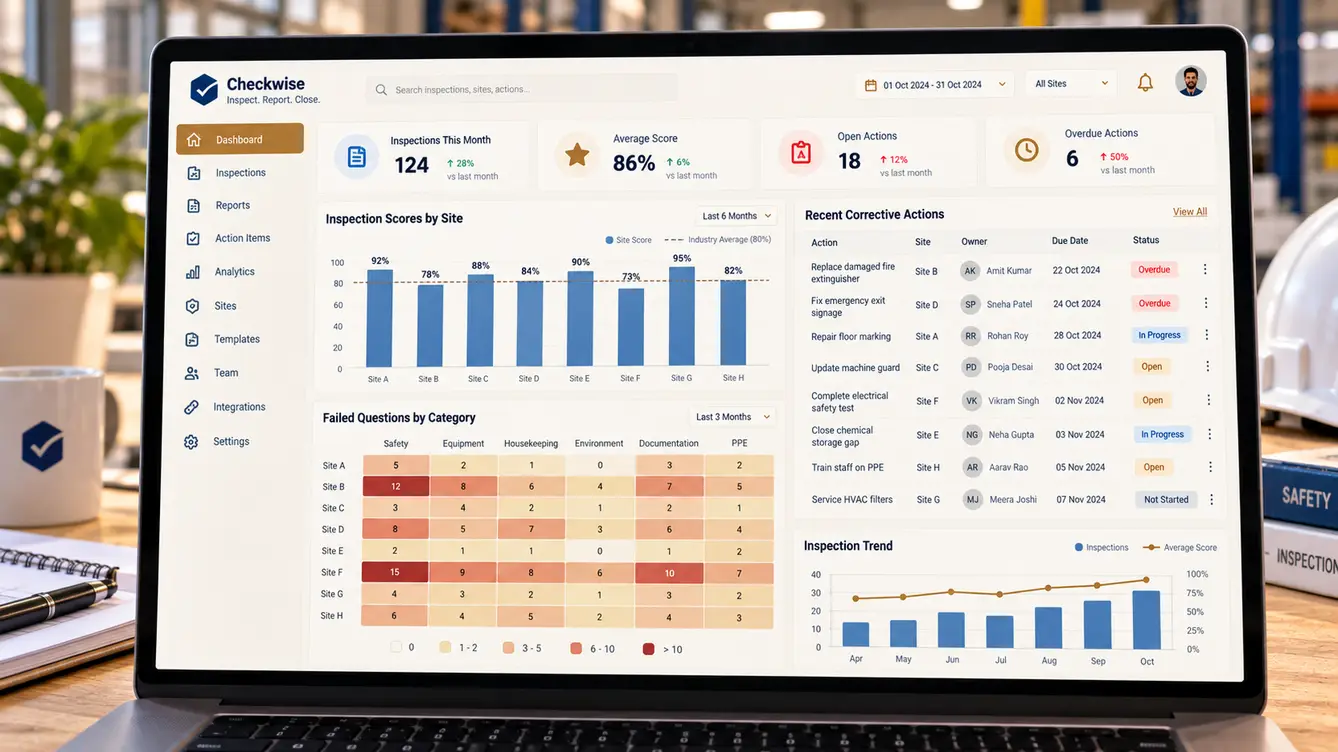
- 14Corrective actions
Failed items assigned with due dates.
- 15Action reminders
Reminders and escalation for overdue actions.
- 16Analytics
Scores and failures by site and category.
- 17Multi-tenancy
Isolated organisations on shared infrastructure.
- 18Subscription billing
Plans, trials and invoices in multiple currencies.
- 19SSO
SAML and OIDC for enterprise customers.
- 20Roles and teams
Admins, reviewers, inspectors and viewers.
- 21Public API
Integrate inspections with other systems.
- 22Webhooks
Events pushed to customer systems.
- 23Inspection scheduling
Recurring inspections by site.
- 24Audit log
Every change recorded per organisation.
- 25Data export
Customers can export all their data.
- 26Usage analytics
Product usage for the Checkwise team.
Launch and growth
Checkwise launched with the founder's network and grew through referrals from inspection managers. Customers in three countries were using it within the first months, several on enterprise plans that required SSO and API access — features built only when those customers asked.
- Weeks 1–2Discovery
Customer interviews and MVP definition.
- Weeks 3–12MVP
Form builder, offline app, reports and actions.
- Weeks 13–14First customers
Launch to the founder's network.
- Weeks 15–22v1 features
Scheduling, analytics, SSO, API and branding.
- Weeks 23–24v1 launch
Enterprise plans and self-serve sign-up.
What we learned
Sell before you scale. Paying customers were the best product managers.
Invest early in the parts that are expensive to change: tenancy, data model and sync.
- Next.js
- React Native
- NestJS
- PostgreSQL with row-level security
- Stripe and Razorpay billing
- SSO (SAML / OIDC)
- PDF report engine
- AWS