
BillableHQ: helping a consulting firm find the hours it was doing but never billing
A management consulting firm suspected it was losing revenue between timesheets, project budgets and invoices, but could not prove where. We built BillableHQ: frictionless time capture, project budgets and burn alerts, resource planning, automated invoicing from approved time and profitability by client and project — giving partners one honest view of utilisation and margin.
Revenue leaking between three systems
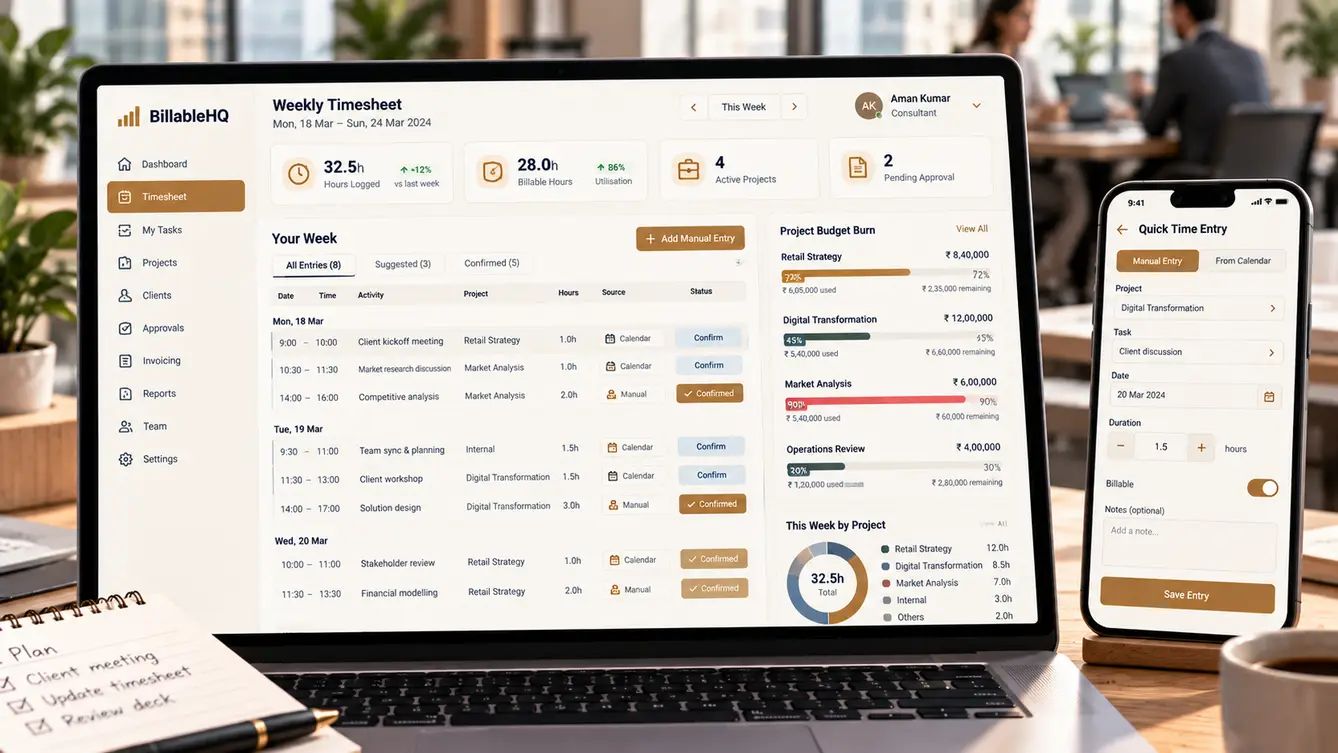
BillableHQ's managing partner could see the symptom: the firm was busy, yet margins were thinner than they should be. Consultants filled timesheets on Friday evenings from memory, projects overran budgets without anyone noticing until the end, and invoices were prepared by hand from spreadsheets that did not match the timesheet system.
“We're not short of work. We're short of knowing what our work earns.”
Reconstructing a quarter
We reconstructed one quarter from calendars, timesheets and invoices. Hours logged were noticeably lower than meeting time alone suggested. Several fixed-fee projects had run far over their estimates, and some approved time on time-and-materials projects had never been invoiced at all.
- Time forgotten by Friday evening
- Budget overruns noticed only at project end
- Approved time never invoiced
- No view of utilisation by consultant

Capture time where it happens
BillableHQ connects to consultants' calendars and suggests time entries from meetings, which consultants confirm or adjust in a click. A mobile widget captures time between meetings. Project budgets update in real time, and managers get alerts as budgets burn past thresholds.
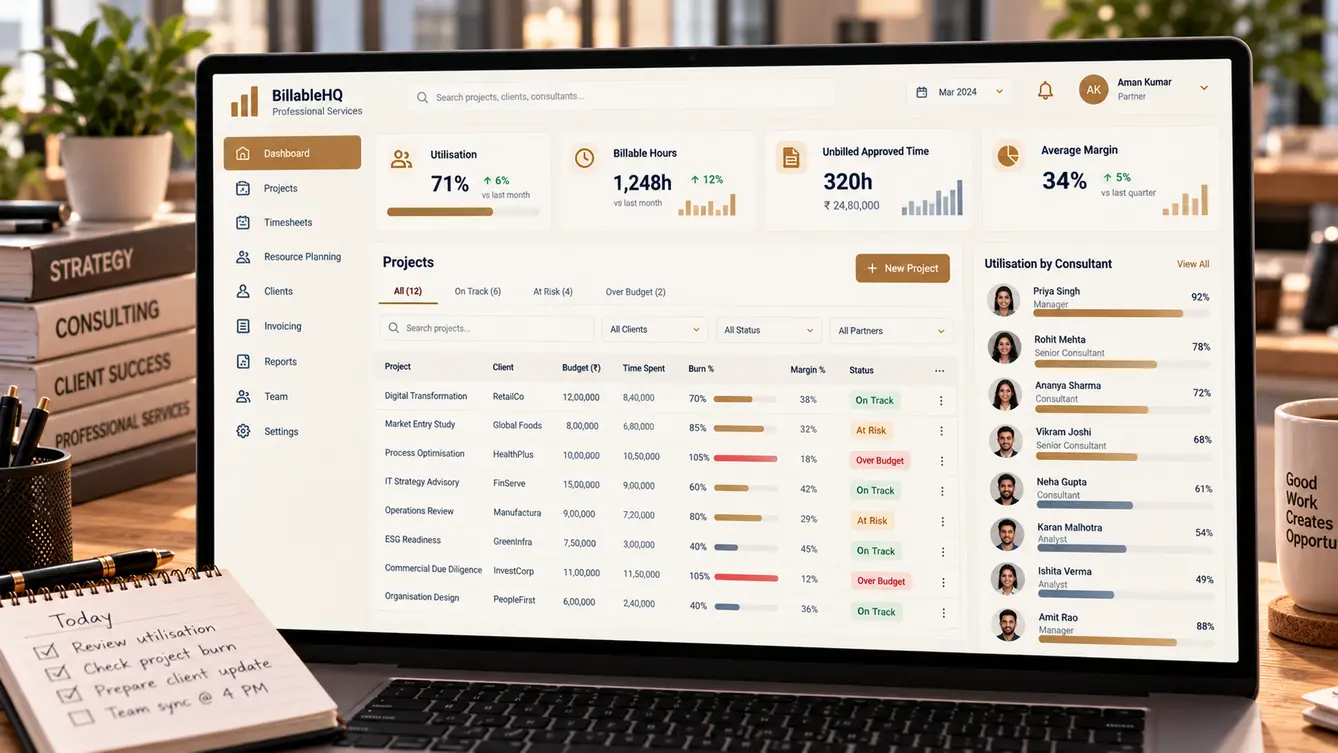
Approved time flows straight into invoices using each client's rate card, and profitability is calculated automatically from time, rates and consultant costs.
The team
A small team focused on making time capture effortless.
Partner workshops and quarter reconstruction.
Time capture and dashboards.
Timesheets, budgets, invoicing and integrations.
Mobile time capture.
Profitability model and suggestions.
6 people in total, working as one team.
Decisions we made
Agreed with the managing partner and finance head.
Manual timesheets or suggestions?
- Better timesheet forms
- Suggestions from calendars, confirmed by consultants
Our call: Suggestions from calendars, confirmed by consultants. Starting from real meetings captured time consultants forgot.
Invoices from where?
- Separate invoice spreadsheets
- Invoices generated from approved time
Our call: Invoices generated from approved time. One data flow meant nothing approved could be left unbilled.
Show consultants their utilisation?
- Only partners see it
- Consultants see their own utilisation
Our call: Consultants see their own utilisation. Transparency encouraged accurate time capture without policing.
Every feature, module by module
Everything that shipped for consultants, managers, finance and partners.
- 01Calendar suggestions
Meetings suggested as time entries.
- 02One-click confirm
Accept or adjust suggestions quickly.
- 03Mobile time entry
Capture time between meetings.
- 04Timers
Start and stop timers per task.
- 05Timesheet approvals
Manager approval workflow.
- 06Project budgets
Hours and fees by phase.
- 07Burn alerts
Alerts at budget thresholds.
- 08Resource planning
Consultant allocation across projects.
- 09Rate cards
Client-specific rates by role.
- 10Automated invoice drafts
Invoices from approved time.
- 11Fixed-fee milestones
Milestone billing for fixed-fee work.
- 12Expenses
Billable expenses with receipts.
- 13Accounting integration
Invoices synced to accounts.
- 14Utilisation dashboard
By consultant, practice and firm.
- 15Profitability by project
Revenue against cost.
- 16Client profitability
Margins across all projects per client.
- 17Unbilled time report
Approved time not yet invoiced.
- 18Role-based access
Consultants, managers, finance and partners.
- 19Audit trail
Time and invoice changes recorded.
Rollout
One practice piloted BillableHQ for a month, then the whole firm moved over. The first month's invoicing run surfaced approved time that had previously gone unbilled — which paid for the project on its own.
- Weeks 1–2Discovery
A quarter reconstructed from calendars and invoices.
- Weeks 3–4Design
Suggested time entries prototyped.
- Weeks 5–12Build
Time, projects, billing and dashboards.
- Weeks 13–15Practice pilot
One practice for a month.
- Week 16Firm-wide launch
All practices.
What we learned
Make the right behaviour effortless. Suggested entries turned timesheets from a chore into a review.
Connect the chain. Time, budgets and invoices had to share one data model to stop leaks.
- Next.js
- React Native
- NestJS
- PostgreSQL
- Calendar integrations
- Accounting system integration
- Suggested time entries model
- AWS Mumbai