
TraceLeaf: letting a European tea buyer scan a pack and see the garden it came from
A tea exporter selling premium teas to Europe faced buyers demanding proof of origin, sustainability and fair labour practices. We built TraceLeaf: garden-to-pack traceability with tamper-evident records anchored on a public blockchain, certification documents linked to each lot, a buyer portal and a consumer QR experience — traceability that stands up to scrutiny.
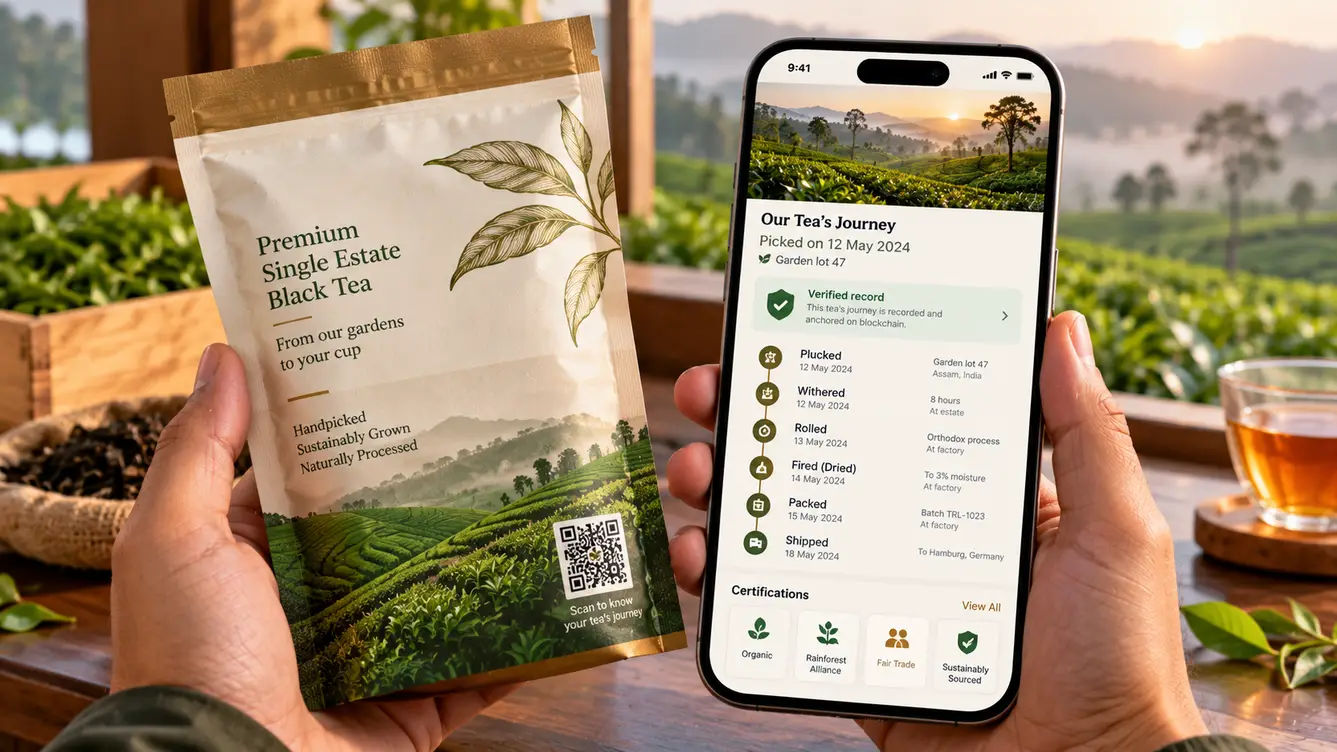
Buyers who wanted proof, not promises
TraceLeaf's managing director sold high-quality teas to European importers. New buyer requirements asked for evidence of origin, processing dates and certifications for each shipment, and some retailers wanted consumers to see the story behind their tea. Spreadsheets and emailed certificates no longer satisfied them.
“Our tea has a story. Our buyers now want evidence for every chapter.”
Following a lot from bush to box
We followed tea from plucking in the garden through withering, rolling, fermenting, drying, sorting, blending and packing. Records existed at each stage — plucking registers, factory logs, lab reports — but on paper and in separate systems, and blending made tracing harder.
- Garden and plucking date for each lot
- Processing steps and dates in the factory
- Blends made from multiple lots
- Certificates linked to the right shipments

Signed events, anchored fingerprints
At each stage, staff record an event — plucked, processed, blended, packed — on a tablet, signed by the recording device and user. Blends link to all their input lots. Periodically, a fingerprint of all events is anchored on a public blockchain, so anyone can verify records were not altered later, without any business data being made public.
Buyers see full lot histories and certificates in a portal; consumers scan a QR code to see a simplified, verifiable story.
The team
A small team with a cryptography engineer for signing and anchoring.
Exporter and importer workshops.
Garden app, buyer portal and consumer pages.
Events, lineage, portal and certificates.
Event signing and anchoring.
5 people in total, working as one team.
Decisions we made
Agreed with the exporter and two importers.
What goes on-chain?
- All traceability data
- Only periodic fingerprints
Our call: Only periodic fingerprints. Business data stays private; fingerprints make tampering detectable.
How to handle blends?
- Trace only single-origin teas
- Link blends to all input lots
Our call: Link blends to all input lots. Most exports were blends; lineage made them traceable too.
Offline recording?
- Online only
- Offline-first in gardens and factory
Our call: Offline-first in gardens and factory. Gardens had patchy connectivity.
Every feature, module by module
Everything that shipped for gardens, the factory, the exporter, buyers and consumers.
- 01Plucking records
Garden sections, dates and quantities.
- 02Processing events
Withering, rolling, drying and sorting.
- 03Blend lineage
Blends linked to input lots.
- 04Signed events
Each event signed by device and user.
- 05Offline recording
Syncs when connected.
- 06Lot and shipment management
Lots assigned to shipments.
- 07Certificate library
Certifications linked to lots.
- 08Lab reports
Quality and residue results.
- 09Blockchain anchoring
Fingerprints recorded publicly.
- 10Buyer portal
Shipment histories and documents.
- 11Integrity verification
Check records were not altered.
- 12Data export
Traceability data for compliance.
- 13QR consumer pages
Garden, journey and certifications.
- 14Multilingual pages
English, German and French.
- 15Verified seal
Shows the record is verifiable.
- 16Role-based access
Gardens, factory, exporter and buyers.
- 17Audit trail
Every event recorded.
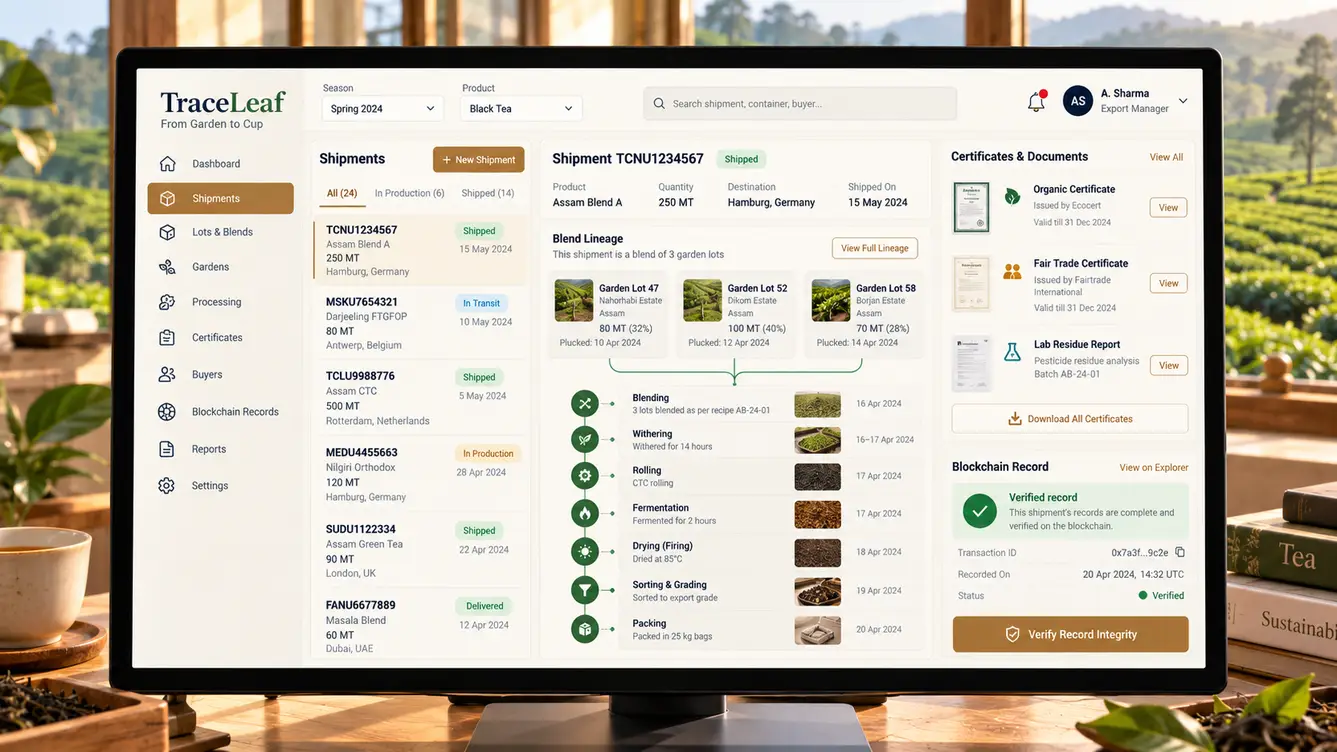
The first traceable export
The first shipment recorded end to end on TraceLeaf went to a European importer with a buyer portal link. The importer's retailer added QR codes to packs, and the story of the garden reached consumers directly.
- Weeks 1–2Discovery
Lot followed from bush to box.
- Weeks 3–4Design
Event model, lineage and anchoring.
- Weeks 5–12Build
Apps, portal, consumer pages and anchoring.
- Weeks 13–15Recording pilot
One garden and factory line.
- Week 16First export
Traceable shipment to Europe.
What we learned
Blockchain is useful for one thing here: proving records were not changed. Everything else belongs in a normal database.
Traceability is a selling point. Buyers valued the evidence as much as compliance.
- Next.js
- React Native
- NestJS
- PostgreSQL
- Public blockchain anchoring (hashes only)
- Signed traceability events
- Offline sync
- AWS Mumbai