PartsBazaar: a B2B marketplace that finds a factory's breakdown spare in hours, not days
When a machine breaks down, a factory's maintenance team starts calling dealers for a part number. A startup wanted to replace those calls with a marketplace connecting factories to verified industrial spares dealers. We built PartsBazaar: part search that understands messy part numbers and photos, RFQs to multiple dealers, verified sellers, credit terms and delivery tracking — 25 features for the moments when a line is down.
A line down and a phone full of dealers
PartsBazaar's founders had both worked in plant maintenance. They described the same scene: a machine stops, the maintenance engineer reads a worn part number, and starts calling dealers in the local industrial market. Each dealer checks stock, calls back, quotes a price. Hours pass. Sometimes the part exists two streets away in a dealer nobody called.
Their idea was a marketplace — but a specialised one, because industrial parts are identified by messy, inconsistent part numbers, brand equivalents and photos of worn components.
“Every hour a line is down costs more than the part. The search is the problem.”
Walking the industrial market
We spent days in the local industrial market with dealers and in factories with maintenance teams. Dealers had deep stock and deeper knowledge, but no online presence. Buyers searched with whatever they had: a partial number, a brand name, a photo. The same bearing could be written a dozen ways.
- Part numbers written many different ways
- Brand equivalents and interchangeable parts
- Buyers who search with a photo
- Credit terms that factories expect

Search that speaks maintenance
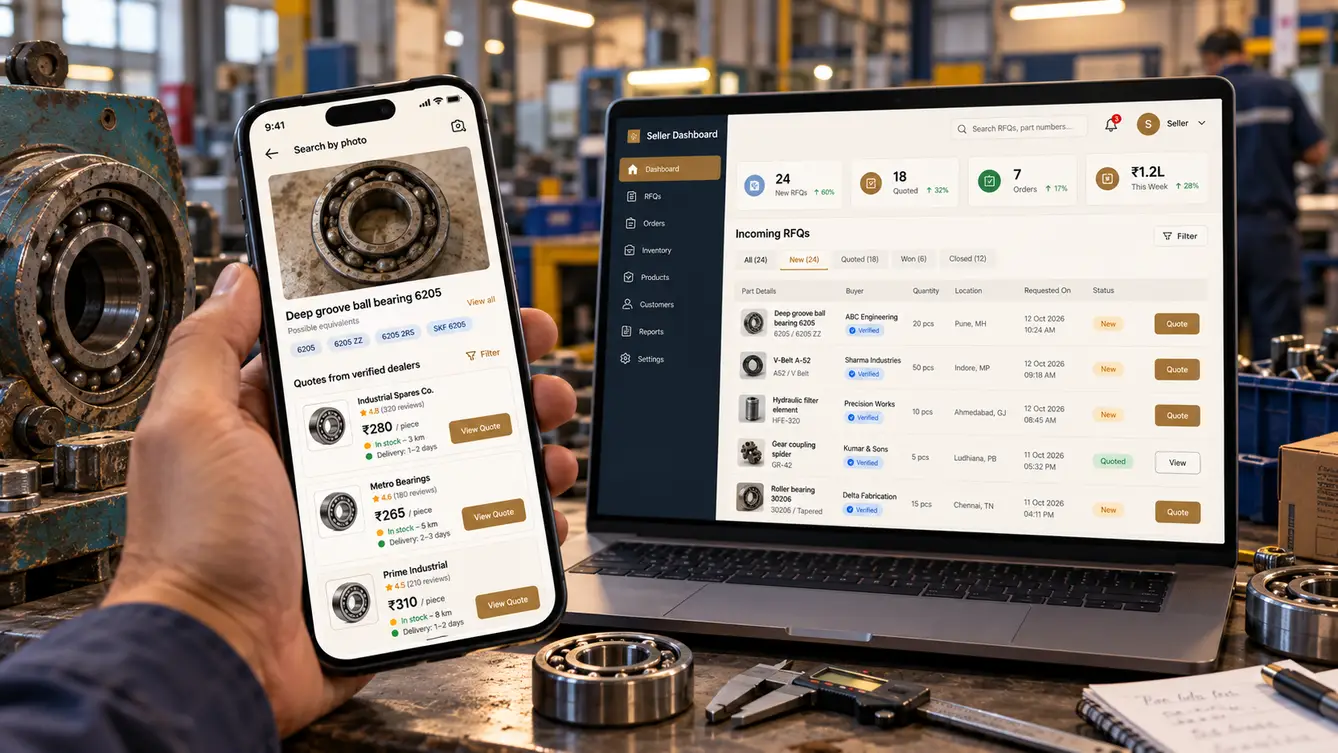
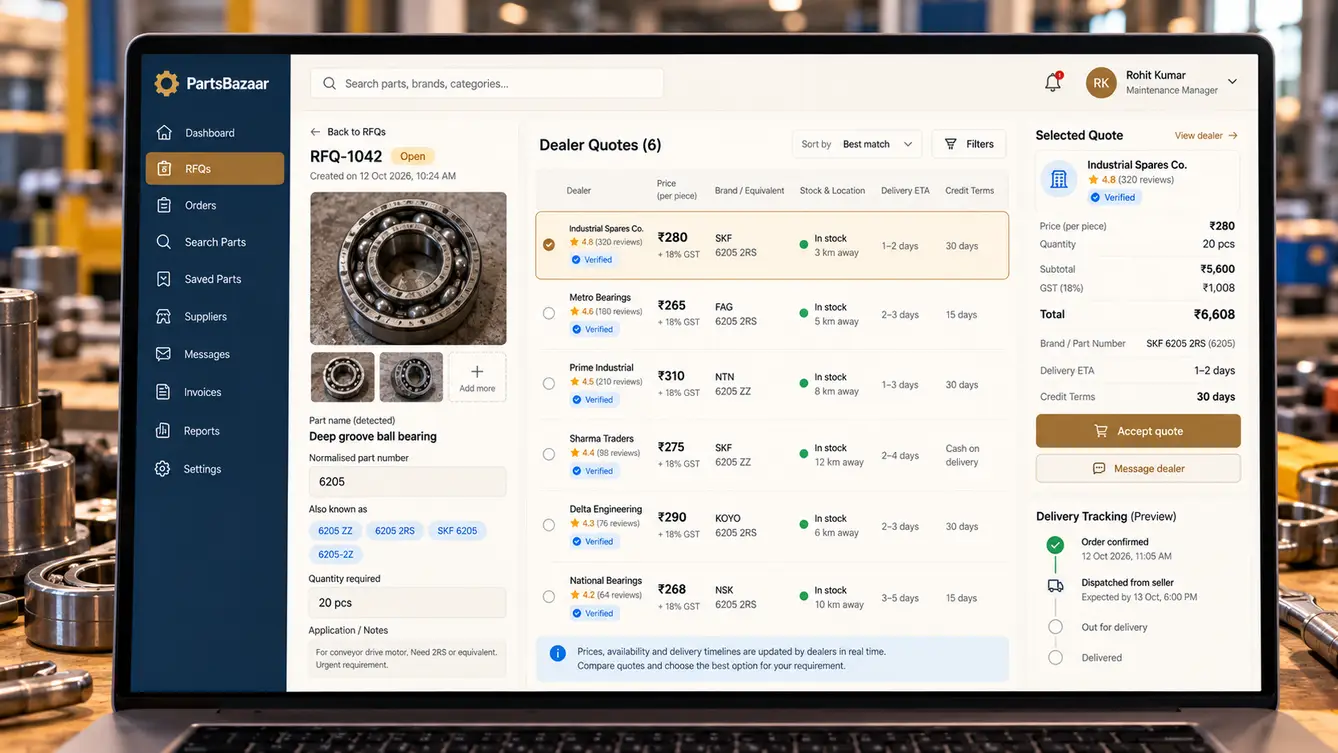
The core of PartsBazaar is search. Part numbers are normalised — spaces, dashes and prefixes stripped, brand-specific formats understood — and linked to known equivalents. Buyers can photograph a part and get likely matches. When a part is not listed, the buyer sends a request for quotation to relevant dealers in one step and receives quotes on WhatsApp and in the app.
Dealers onboard quickly: upload a stock sheet in whatever format they have, and the system maps it to the catalogue.
The team
Search and catalogue quality drove the team, with an AI engineer on part matching from day one.
Market research, launch strategy and roadmap.
Buyer search, RFQ flow and seller dashboard.
Marketplace, orders, credit and logistics.
Buyer app with photo search.
Part-number normalisation, equivalents and image matching.
6 people in total, working as one team.
Decisions we made
Agreed with the founders, who knew both sides of the market.
Catalogue-first or RFQ-first?
- Only list catalogued parts
- Catalogue plus RFQ for anything not listed
Our call: Catalogue plus RFQ for anything not listed. No catalogue covers every industrial part. RFQs meant buyers always got an answer.
How should dealers onboard?
- Manual product entry
- Upload any stock sheet, mapped automatically
Our call: Upload any stock sheet, mapped automatically. Dealers would never type thousands of items. Automatic mapping made onboarding take minutes.
Offer credit?
- Prepaid only
- Credit terms through a financing partner
Our call: Credit terms through a financing partner. Factories buy on credit. Without it, the marketplace would not fit how they purchase.
Launch nationally or locally?
- National launch
- One industrial market first
Our call: One industrial market first. Local density meant nearby stock and fast delivery, which proved the model.
The 25 features
Everything that shipped for buyers, sellers and operations.
- 01Part-number normalisation
Matches however the number is written.
- 02Equivalent parts
Interchangeable parts across brands.
- 03Photo search
Photograph a part to find matches.
- 04Nearby stock
Results sorted by distance and availability.
- 05Specifications filters
Filter by dimensions and ratings.
- 06Request for quotation
One request sent to several dealers.
- 07Quote comparison
Price, brand, stock and delivery side by side.
- 08Urgent orders
Priority flag for breakdowns.
- 09Credit terms
Buy on credit through a financing partner.
- 10Order tracking
Dispatch and delivery status.
- 11WhatsApp ordering
RFQs and quotes on WhatsApp.
- 12Stock sheet upload
Any format, mapped automatically.
- 13RFQ inbox
Respond to requests quickly.
- 14Seller verification
Business and quality checks.
- 15Payouts
Settlements tracked per order.
- 16Seller analytics
Views, RFQs and conversion.
- 17Catalogue management
Parts, equivalents and specifications.
- 18Delivery partners
Local delivery integration.
- 19Returns and disputes
Wrong-part returns handled.
- 20Buyer accounts
Factories with multiple users and approvers.
- 21Role-based access
Buyers, approvers, sellers and operations.
- 22Marketplace analytics
Searches, fill rate and delivery times.
- 23GST invoicing
Compliant invoices for every order.
- 24Audit trail
Quotes, orders and changes recorded.
- 25Demand insights
Unfulfilled searches shared with sellers.
Launch in one market
We launched with dealers in a single industrial market and factories in the surrounding belt, so every search had a real chance of finding stock nearby. Density mattered more than reach; expansion to other markets followed once one market worked.
- Weeks 1–2Discovery
Days in the industrial market and factories.
- Weeks 3–4Design
Search, RFQ and seller onboarding prototyped.
- Weeks 5–12Build
Marketplace, search, apps and integrations.
- Weeks 13–14Seller onboarding
Dealers in one market onboarded.
- Weeks 15–16Launch
Factories in the surrounding belt invited.
What we learned
In B2B marketplaces, search quality is the product. Normalising part numbers mattered more than any feature.
Win one market before many. Local density made the marketplace useful from day one.
- Next.js
- React Native
- NestJS
- PostgreSQL
- Search with part-number normalisation
- Image-based part recognition
- Credit and payments integration
- AWS Mumbai