ChargeGrid: an EV charging app drivers could rely on, backed by a network operators could actually manage
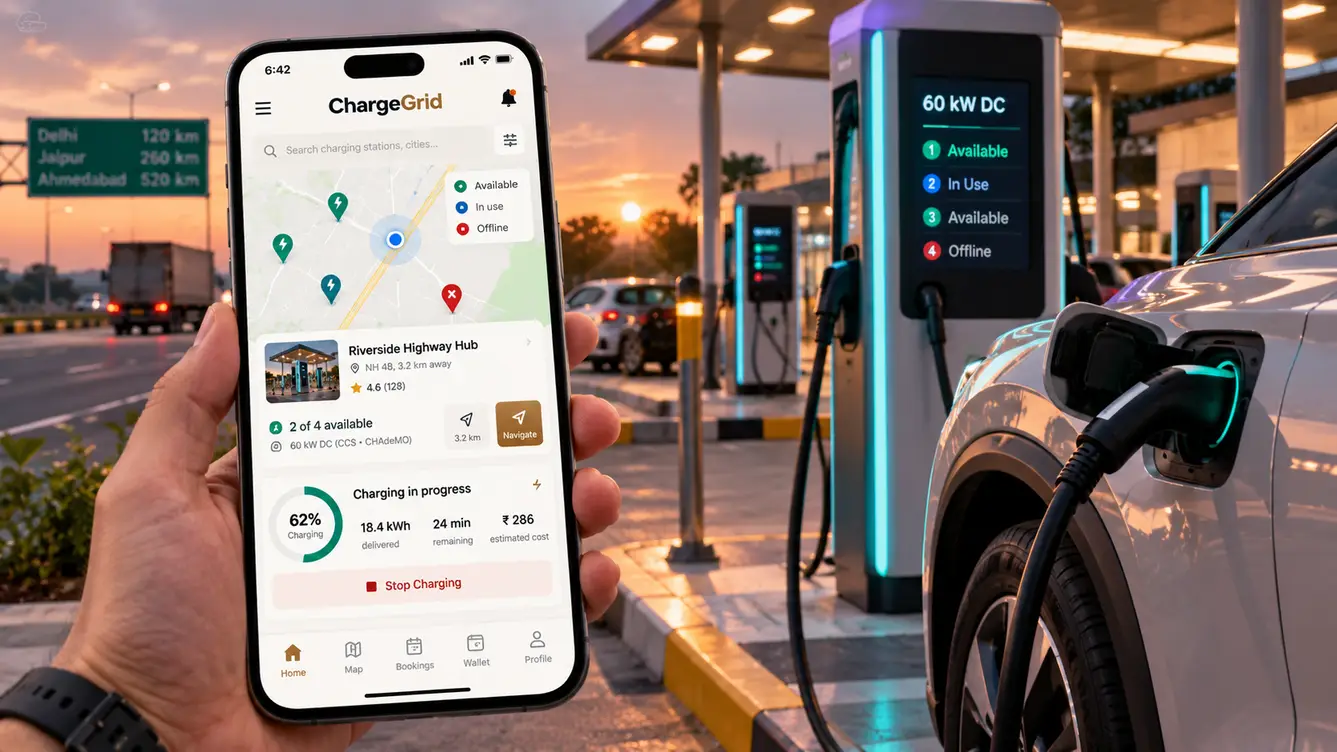
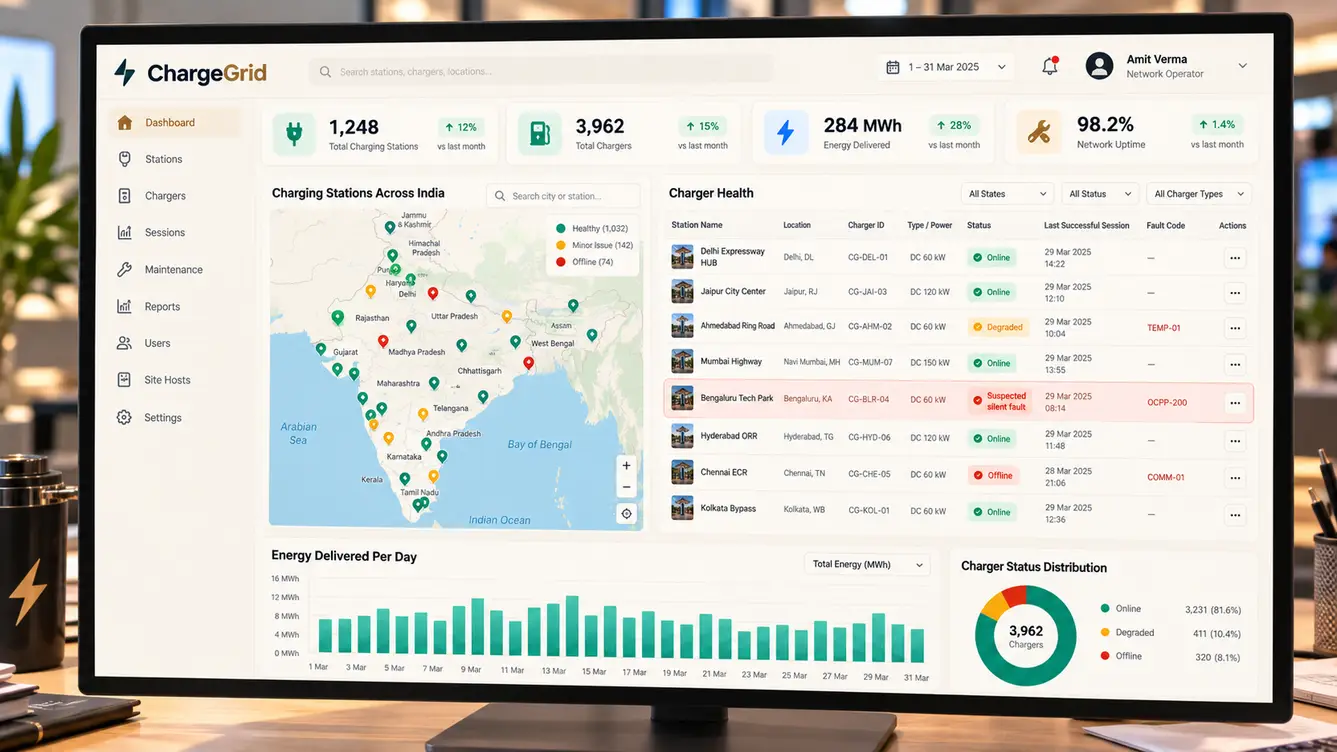
An EV charging operator was expanding across highways and cities, but drivers could not tell which chargers were working, and the operations team learned about faults from angry reviews. We built ChargeGrid: a driver app with live charger status, booking and UPI payment, a charger management system over OCPP, fault detection with field dispatch and site-host revenue sharing.
Arriving at a broken charger
ChargeGrid's CEO read us a review: a family had driven forty minutes out of their way on a highway to a charger the app showed as available, only to find it offline. For EV drivers, charger reliability is not a convenience — it decides whether they complete their journey.
Behind the scenes, the network ran on chargers from several manufacturers with their own portals, and the operations team had no single view of what was working.
“Range anxiety is really reliability anxiety.”
Understanding the network
We audited the network: chargers from several manufacturers, each speaking the OCPP protocol slightly differently, on patchy mobile connections. Faults ranged from payment terminal failures to cable damage to chargers silently stuck in a fault state while reporting available.
- Chargers reporting available while faulted
- Different manufacturers, different OCPP quirks
- Faults discovered by drivers, not operators
- No single view across the network
One brain for every charger
ChargeGrid runs its own OCPP server that every charger connects to, with adapters for each manufacturer's quirks. It checks chargers' health continuously — not just what they report, but whether sessions actually start and deliver energy. Suspect chargers are marked unavailable in the driver app before a driver arrives, and a technician is dispatched.
Drivers see honest availability, can reserve a connector, start charging from the app and pay by UPI. Site hosts see sessions and their revenue share.
The team
OCPP expertise and reliability engineering led the team.
Network audit and migration planning.
Driver app and operations console.
OCPP server, adapters and health checks.
Driver and technician apps.
Reliability, monitoring and alerting.
6 people in total, working as one team.
Decisions we made
Agreed with the CEO and head of network operations.
Use manufacturers' portals or our own OCPP server?
- Manufacturer portals
- Own OCPP server with adapters
Our call: Own OCPP server with adapters. One server gave a single view, consistent behaviour and control over the driver experience.
Trust reported status?
- Show what chargers report
- Verify health from real session outcomes
Our call: Verify health from real session outcomes. Chargers could report available while broken; outcomes told the truth.
Payment method?
- RFID cards and wallets
- UPI plus RFID cards for fleets
Our call: UPI plus RFID cards for fleets. UPI suited individual drivers; RFID suited fleet operators.
Every feature, module by module
Everything that shipped for drivers, operations, technicians and site hosts.
- 01Live charger map
Verified availability by connector.
- 02Route planning
Chargers along a trip.
- 03Reservations
Hold a connector before arrival.
- 04Start from app
Scan QR or tap to start.
- 05Live session
Energy, time and cost.
- 06UPI payments
Pay per session.
- 07OCPP server
Every charger connected centrally.
- 08Manufacturer adapters
Quirks handled per vendor.
- 09Health verification
Silent faults detected from sessions.
- 10Remote actions
Reset, unlock and update remotely.
- 11Tariff management
Prices by site and time.
- 12Fault tickets
Created automatically.
- 13Technician app
Tickets, diagnostics and photos.
- 14Maintenance schedules
Preventive visits.
- 15Site-host portal
Sessions and revenue share.
- 16Fleet accounts
RFID cards and monthly billing.
- 17Energy analytics
Energy delivered and utilisation.
- 18Role-based access
Drivers, operators, technicians and hosts.
- 19Audit trail
Sessions and remote actions recorded.
Launch
Chargers were migrated to ChargeGrid's server manufacturer by manufacturer. Once health checks were live, the app's availability became trustworthy, and review complaints about dead chargers dropped away.
- Weeks 1–3Network audit
Chargers, vendors and faults catalogued.
- Weeks 4–5Design
Driver app and health model.
- Weeks 6–15Build
OCPP server, adapters, apps and portals.
- Weeks 16–19Migration
Chargers moved vendor by vendor.
- Week 20Network-wide launch
All chargers on ChargeGrid.
What we learned
Verify, don't trust, device status. Checking real sessions caught silent faults.
Honest availability builds loyalty. Drivers preferred fewer 'available' pins that were real.
- React Native
- Next.js
- Node.js
- OCPP 1.6 / 2.0.1 server
- PostgreSQL
- TimescaleDB
- UPI payments
- AWS Mumbai