
CarbonLens: helping mid-sized exporters measure their carbon footprint before their buyers demand it
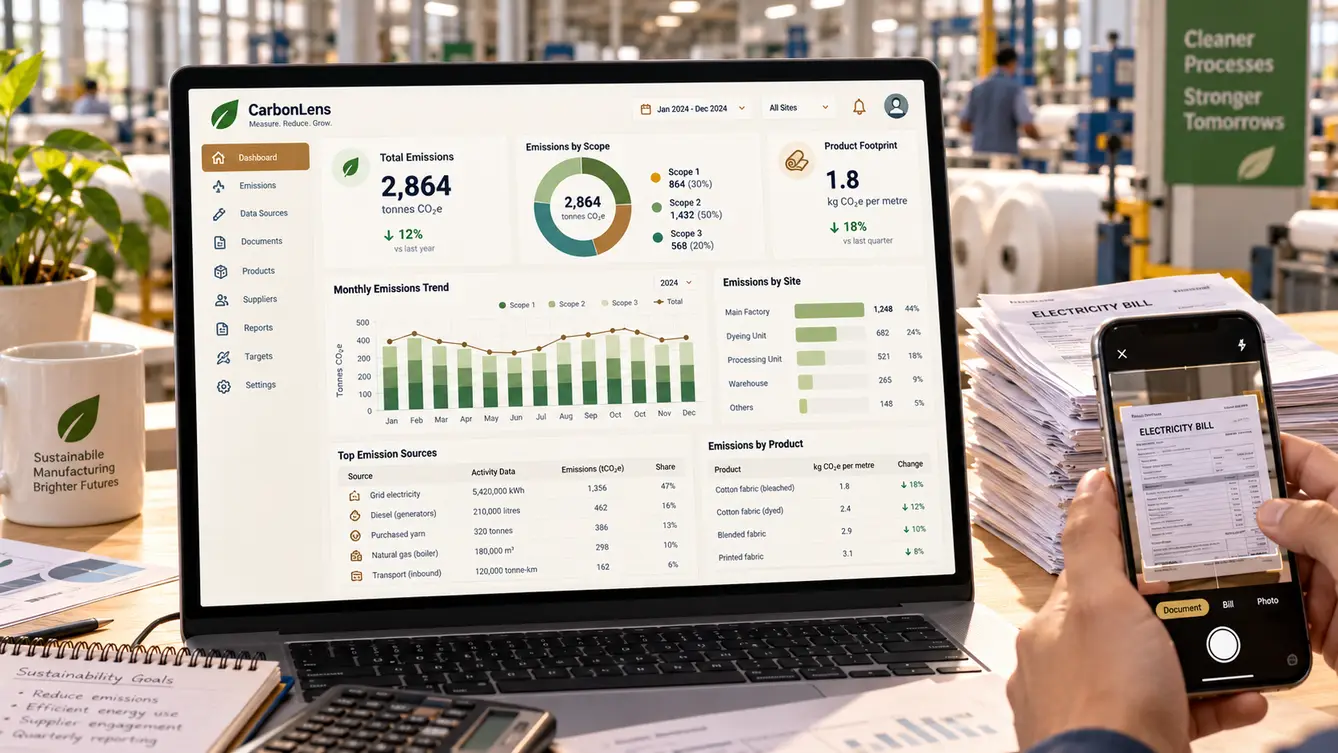
European buyers had started asking a group of mid-sized Indian manufacturers for emissions data, and new border rules were coming. The manufacturers had no idea where to start. We built CarbonLens: automated data collection from bills and meters, emissions calculations across scopes 1, 2 and 3, product-level carbon footprints, supplier surveys and buyer-ready reports — 24 features that turn utility bills into answers.
A buyer's questionnaire nobody could answer
CarbonLens began with a questionnaire. A European buyer asked a textile exporter for its emissions — by scope, by product, with methodology. The exporter's owner forwarded it to his industry association, which found that none of its members could answer it. New carbon border rules in Europe meant these questions would soon be commercial requirements, not polite requests.
Consultants offered one-off carbon studies at high prices. Members needed something they could update every quarter themselves.
“We can make fabric for any buyer in the world. We can't tell them what it emits.”
Where the data actually lives
We visited factories and found the data already existed — scattered. Electricity bills, diesel purchase invoices, boiler fuel records, raw material purchase registers and transport invoices. Nobody had connected them to emissions because nobody had the time or the method.
The design principle became: collect from documents the factory already has, calculate using recognised methods and published emission factors, and show every number's source.
- Electricity bills and sub-meter readings
- Diesel, gas and boiler fuel purchases
- Raw material purchases by supplier
- Transport and logistics invoices
Accurate enough, transparent always
CarbonLens extracts quantities from uploaded bills and invoices, maps each to an activity, and applies emission factors from recognised published sources, with every factor and its source visible. Scope 3 — emissions from suppliers — starts with spend-based estimates and improves as suppliers answer short surveys in the supplier portal.
Product footprints allocate factory emissions to products by production volume and energy use, giving buyers the per-unit numbers they ask for, with the method documented.
The team
A sustainability methodology specialist reviewed every calculation alongside the engineering team.
Association working group and pilot companies.
Methodology, emission factors and review.
Company app, supplier portal and reports.
Calculation engine and factor library.
Bill and invoice extraction.
Web app, portal and report sharing.
6 people in total, working as one team.
Decisions we made
Agreed with the association's working group.
New data collection or existing documents?
- Factories enter data manually
- Extract from bills and invoices they already have
Our call: Extract from bills and invoices they already have. Factories had no time for new processes. Using existing documents made adoption realistic.
How precise should Scope 3 be at first?
- Wait for supplier data
- Start with spend-based estimates, refine with supplier surveys
Our call: Start with spend-based estimates, refine with supplier surveys. Buyers needed answers now. Estimates improved over time as suppliers responded.
Show sources?
- Show totals only
- Every number traceable to documents and factors
Our call: Every number traceable to documents and factors. Buyers and auditors need to see how numbers were calculated.
Consultancy report or software?
- One-off consultancy study
- Software members update themselves
Our call: Software members update themselves. Emissions must be reported repeatedly. Software made updates cheap and routine.
The 24 features
Everything that shipped for companies, suppliers and buyers.
- 01Bill and invoice upload
Upload electricity, fuel and purchase documents.
- 02Automatic extraction
Quantities and dates read from documents.
- 03Meter integration
Sub-meter data where available.
- 04Activity mapping
Each entry mapped to an emission activity.
- 05Data gap alerts
Missing months and sources flagged.
- 06Scope 1 and 2 emissions
Fuels and purchased electricity.
- 07Scope 3 estimates
Spend-based and supplier-specific.
- 08Emission factor library
Published factors with sources and years.
- 09Product carbon footprints
Per-unit footprints by product line.
- 10Calculation audit trail
Every number traceable to inputs.
- 11Supplier surveys
Short surveys in a supplier portal.
- 12Supplier data quality
Scores by completeness and evidence.
- 13Supplier reminders
Automated follow-ups.
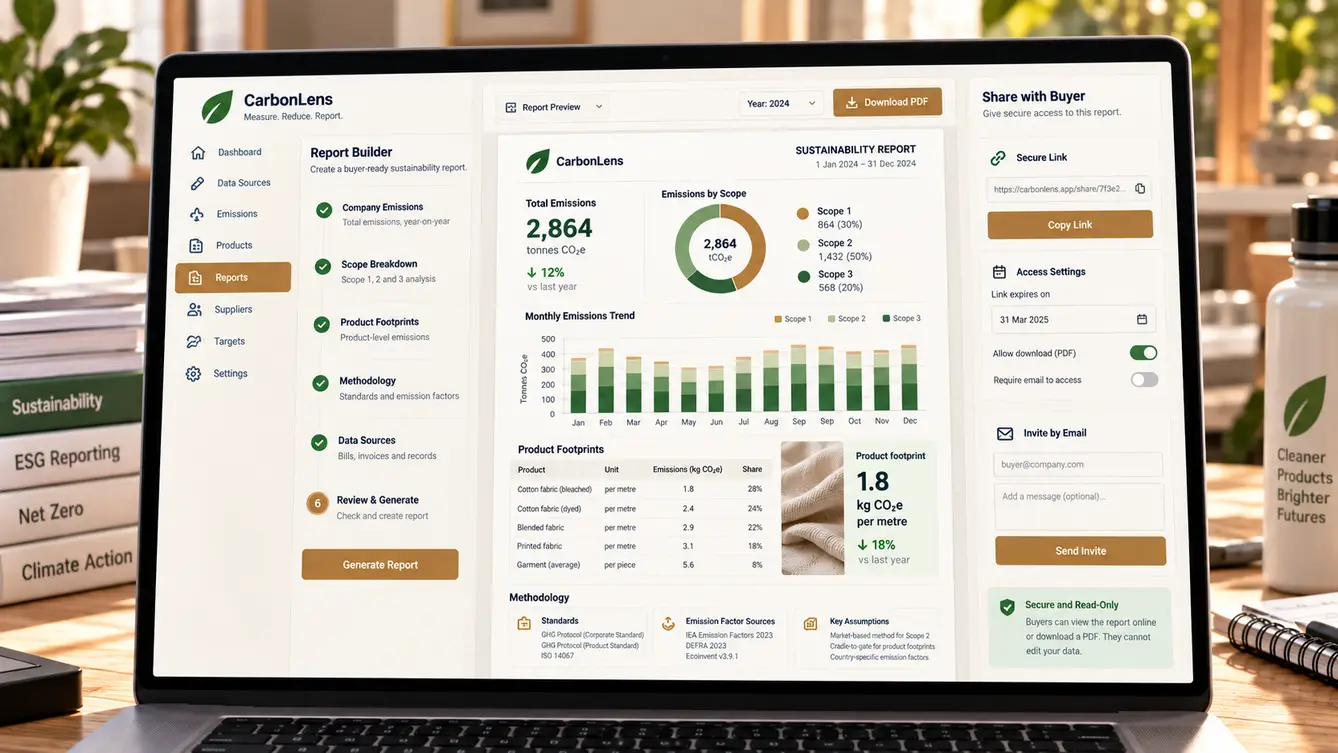
- 14Buyer-ready reports
Emissions, methodology and sources.
- 15Secure report sharing
Links with access expiry.
- 16Reduction opportunities
Largest sources and suggested actions.
- 17Targets and tracking
Reduction targets with progress.
- 18Peer benchmarks
Anonymised comparison within the association.
- 19Role-based access
Company users, suppliers, reviewers and buyers.
- 20Multi-site support
Several factories under one company.
- 21Data export
Export for auditors and other tools.
- 22Reviewer sign-off
Internal or external reviewer approves each period.
- 23Reporting periods
Quarterly and annual periods with locked history.
- 24Export-market templates
Report formats for common buyer and regulatory requests.
Rollout with the association
Five member companies piloted CarbonLens, each uploading a year of bills and invoices. Their first reports went to buyers within weeks, and the association then opened CarbonLens to all members with shared emission-factor libraries and peer benchmarks.
- Weeks 1–3Discovery
Factory visits and buyer questionnaires reviewed.
- Weeks 4–5Methodology
Calculation approach agreed with the working group.
- Weeks 6–13Build
Extraction, calculation engine, supplier portal and reports.
- Weeks 14–16Five-company pilot
A year of documents per company; first buyer reports.
- Weeks 17–18Association launch
Open to all members with benchmarks.
What we learned
Start from the documents people already have. Asking factories for new data collection would have failed.
Transparency is credibility. Buyers accepted the numbers because every one traced to a bill and a published factor.
- Next.js
- Python / FastAPI
- PostgreSQL
- Document extraction for bills and invoices
- Emission factor library
- Meter integrations
- AWS Mumbai